Dimensionality Reduction
Modern omics data have many features, and dimensionality reduction methods help create overview visualizations.
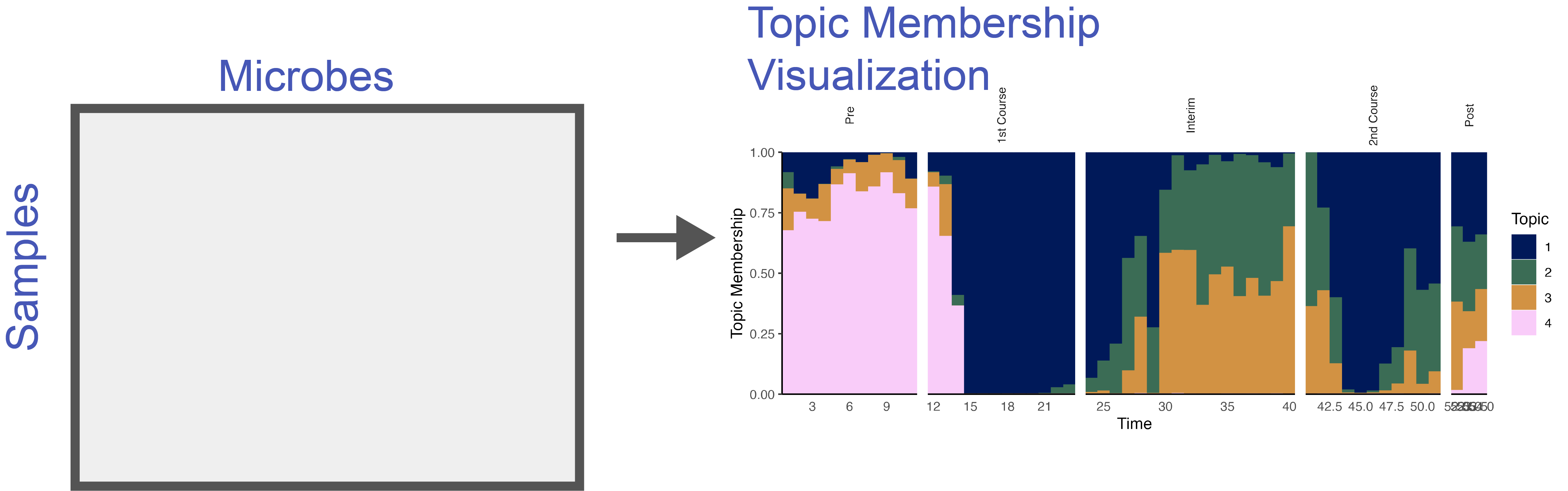
They can summarize microbiome community structure
\(\def\Dir{\text{Dir}}\) \(\def\Mult{\text{Mult}}\) \(\def\*#1{\mathbf{#1}}\) \(\def\m#1{\boldsymbol{#1}}\) \(\def\Unif{\text{Unif}}\) \(\def\win{\tilde{w}_{\text{in}}}\) \(\def\reals{\mathbb{R}}\) \(\newcommand{\wout}{\tilde w_{\text{out}}}\)
Dimensionality Reduction
Modern omics data have many features, and dimensionality reduction methods help create overview visualizations.
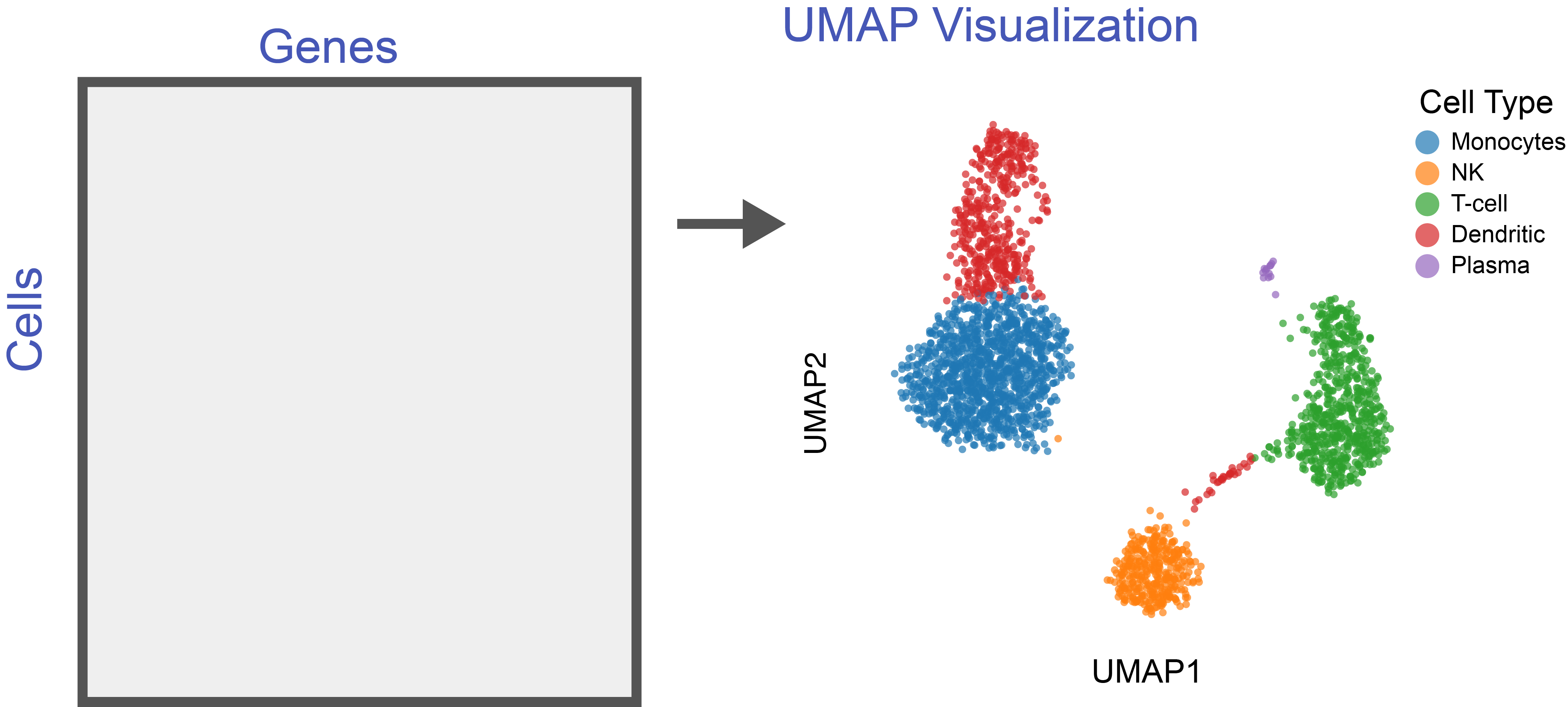
They are also used in cell atlas construction and trajectory inference.
Microbiome Analogy
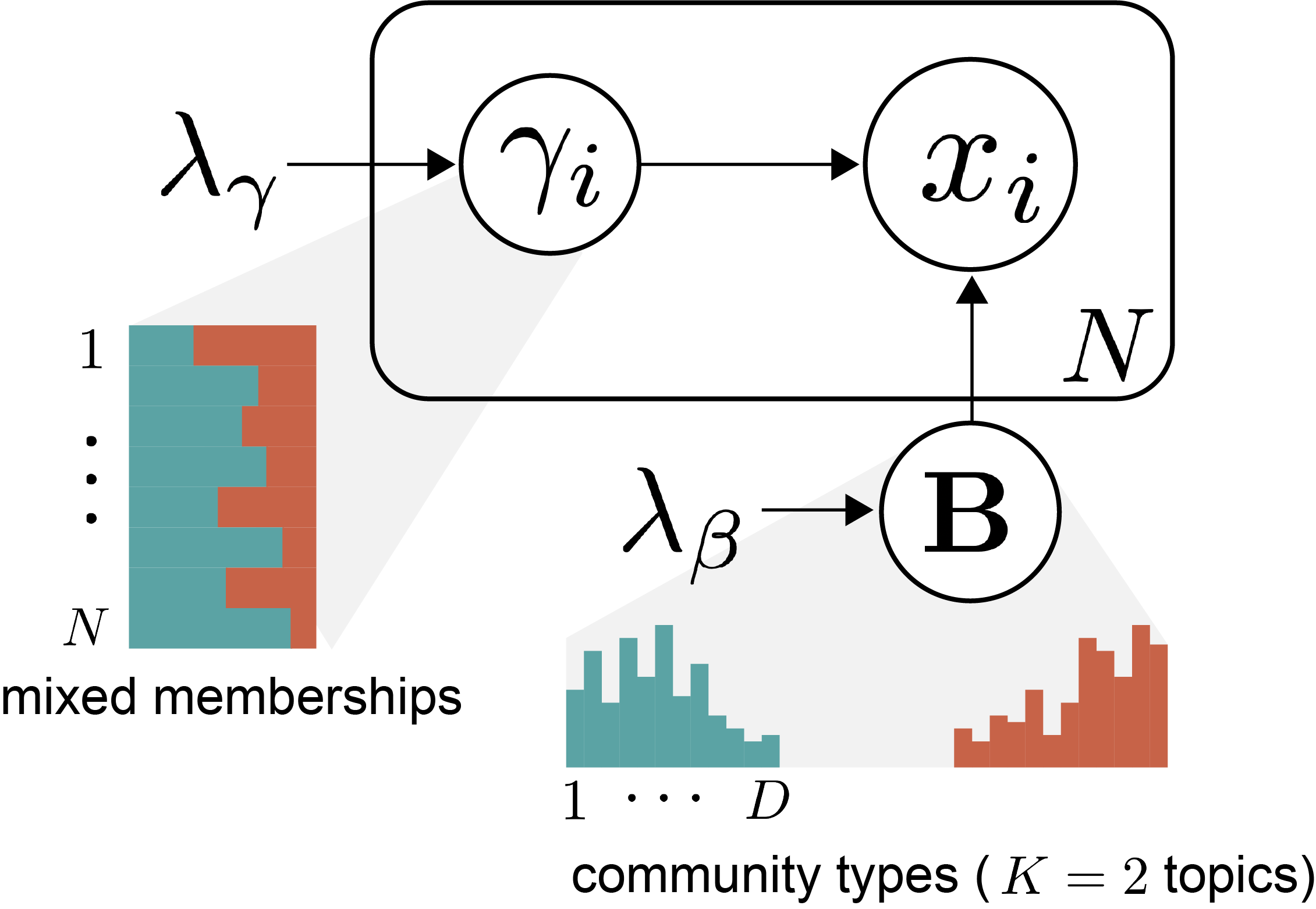
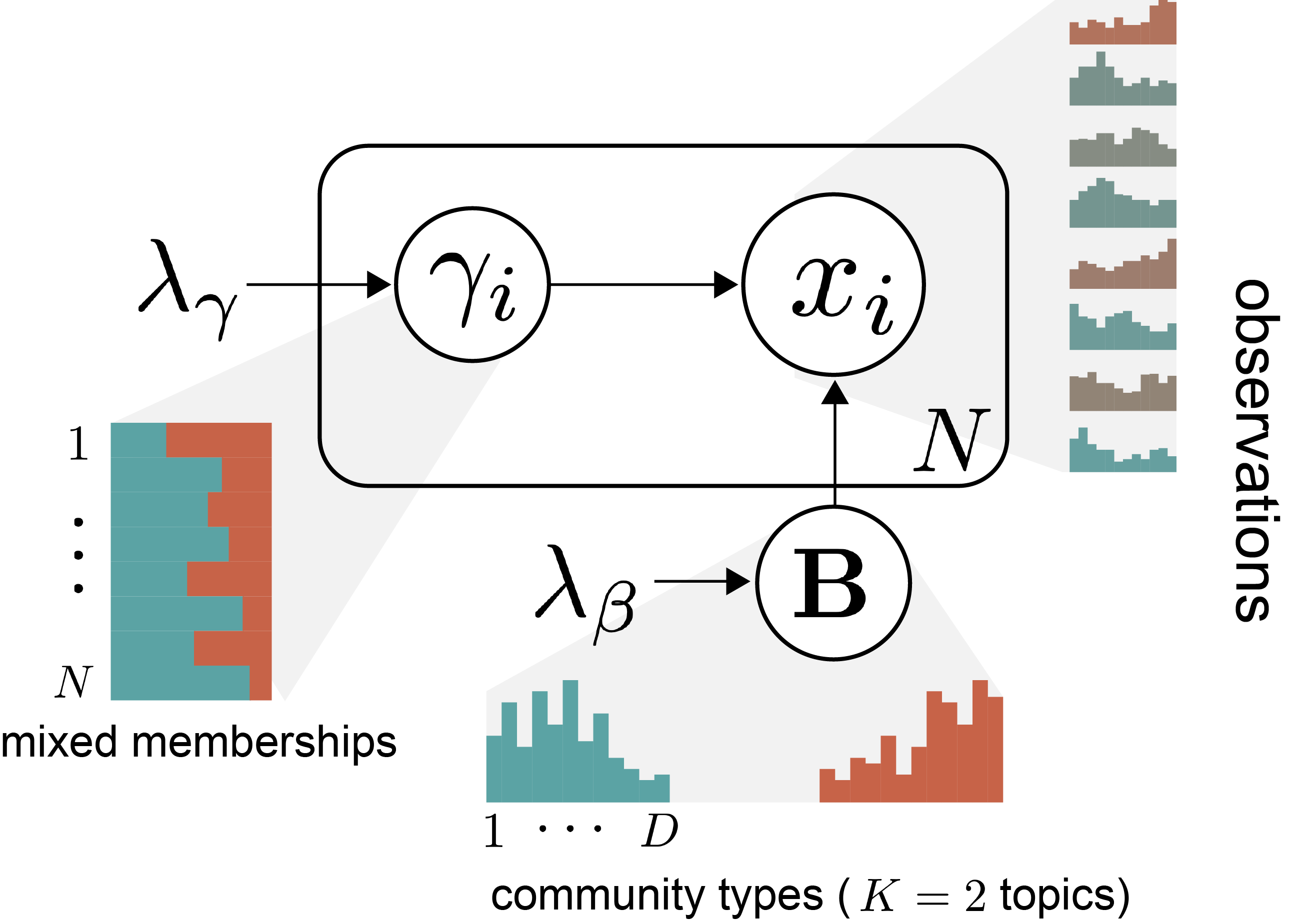
- Topics: \(\beta_{k}\) describes \(K\) underlying community types.
- Memberships: \(\gamma_{i}\) describes sample \(x_i\) as a mixture of community types.
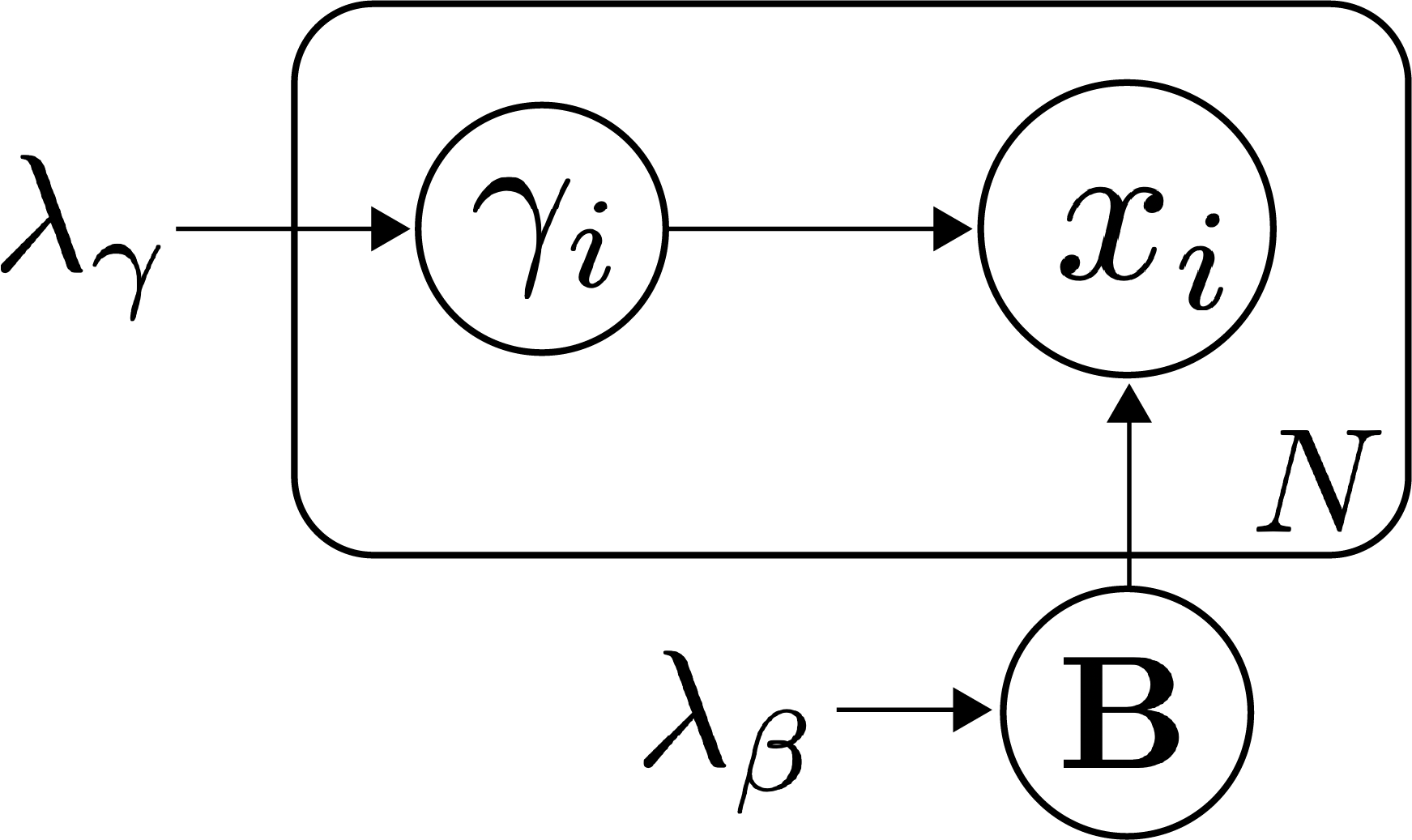
Microbiome Analogy
- Topics: \(\beta_{k}\) describes \(K\) underlying community types.
- Memberships: \(\gamma_{i}\) describes sample \(x_i\) as a mixture of community types.
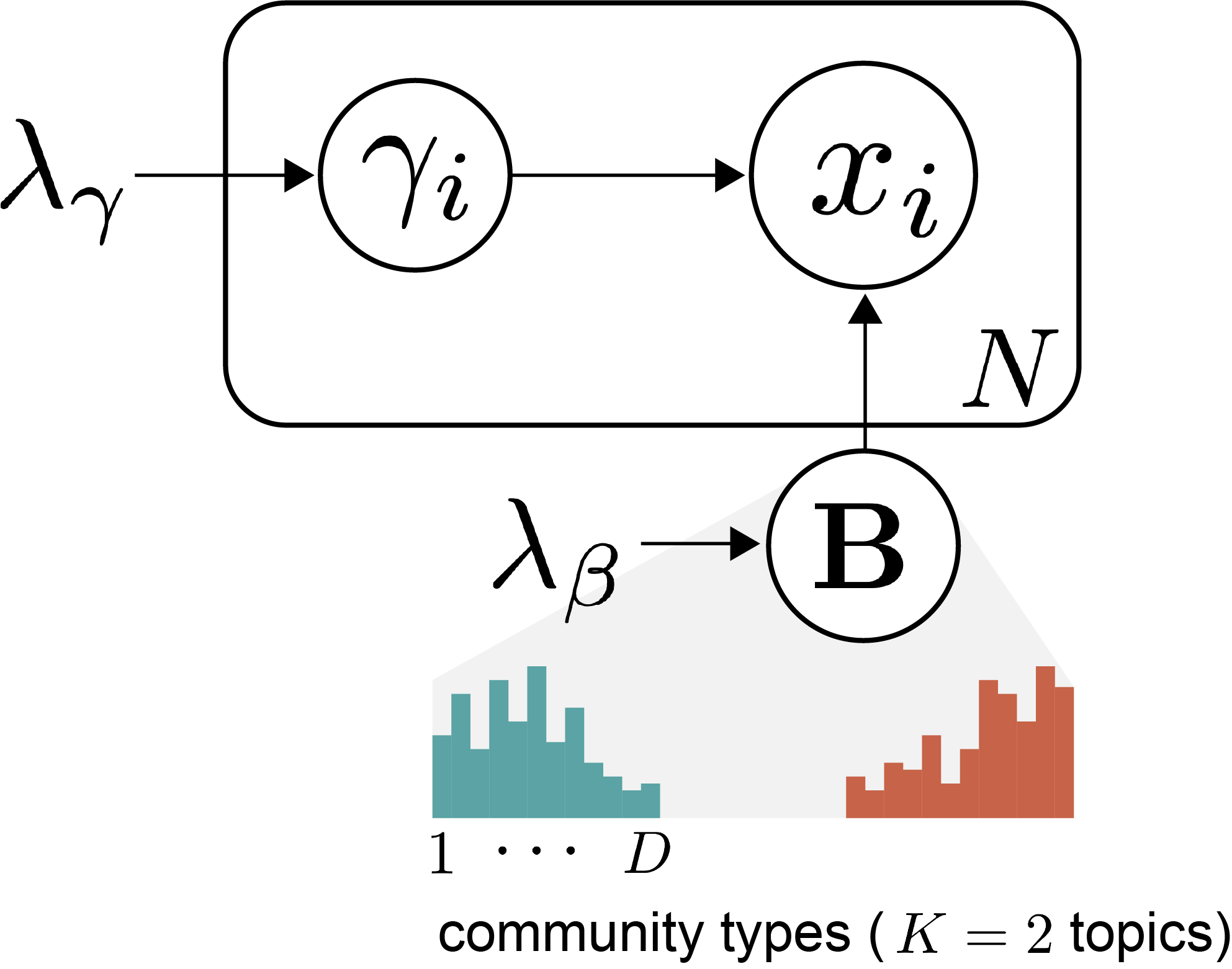
Microbiome Analogy
- Topics: \(\beta_{k}\) describes \(K\) underlying community types.
- Memberships: \(\gamma_{i}\) describes sample \(x_i\) as a mixture of community types.
Microbiome Analogy
- Topics: \(\beta_{k}\) describes \(K\) underlying community types.
- Memberships: \(\gamma_{i}\) describes sample \(x_i\) as a mixture of community types.
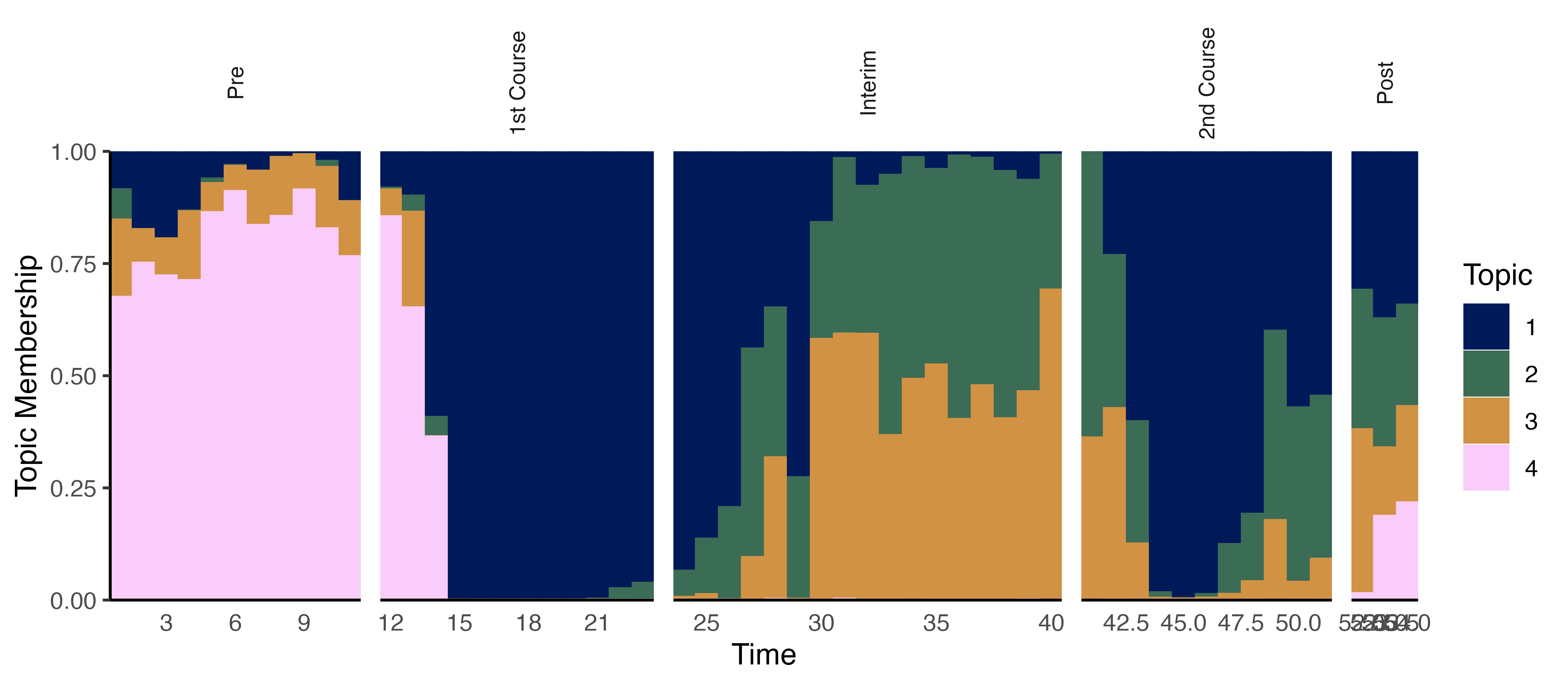
Example: Antibiotics Time Course
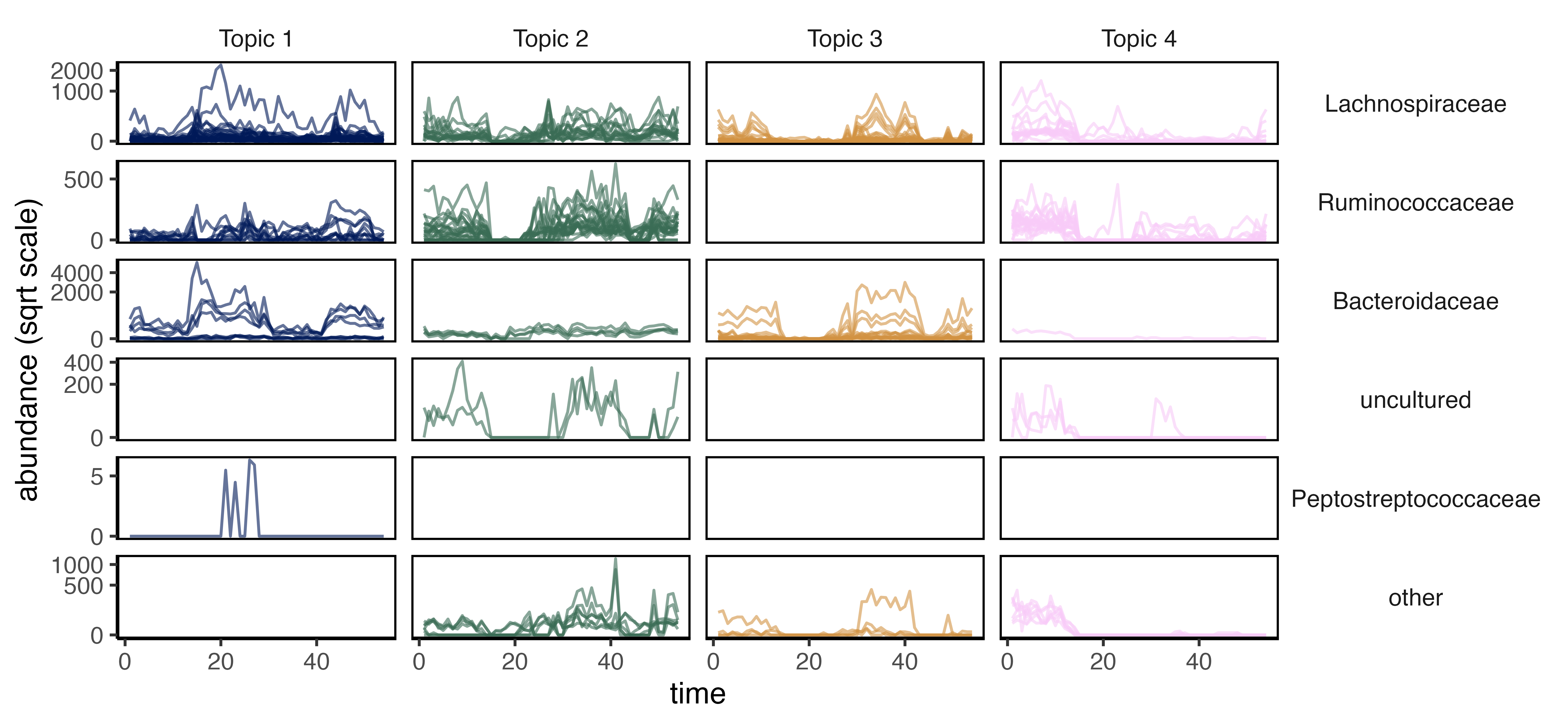
If we use topic models, Topic 2 increases during the antibiotic interventions, especially the first (Sankaran and Holmes 2018).
alto: Main Idea
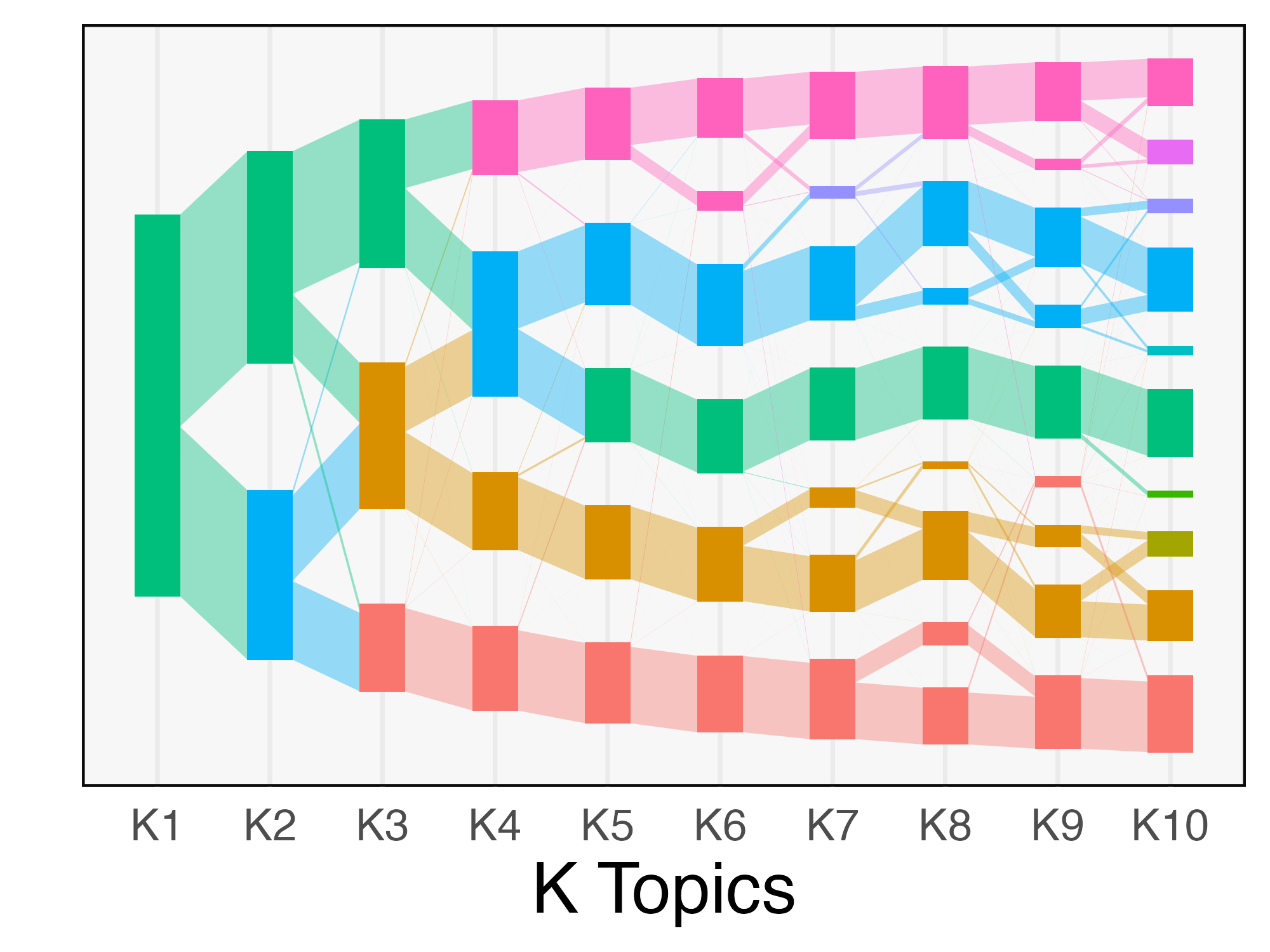
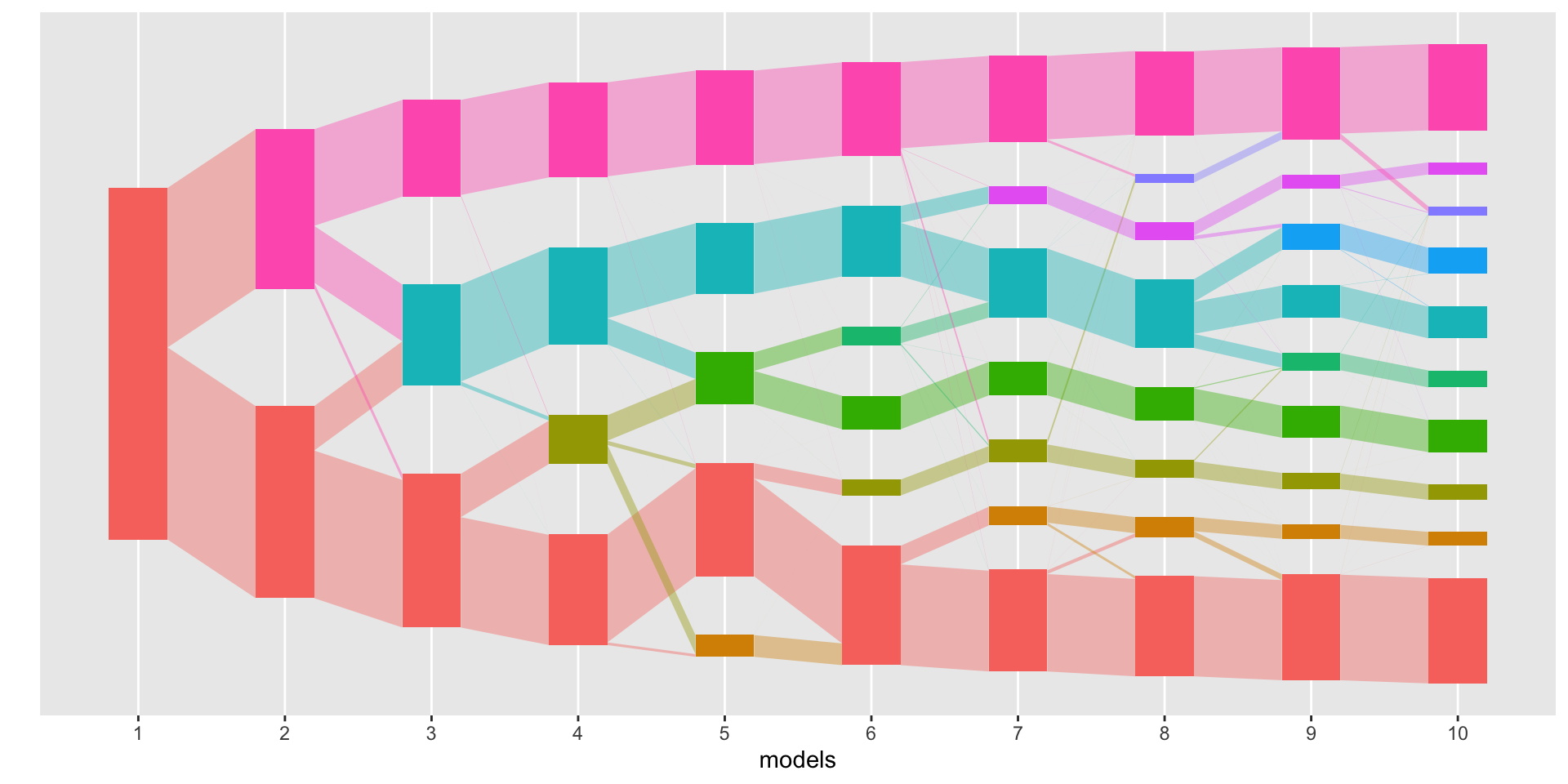
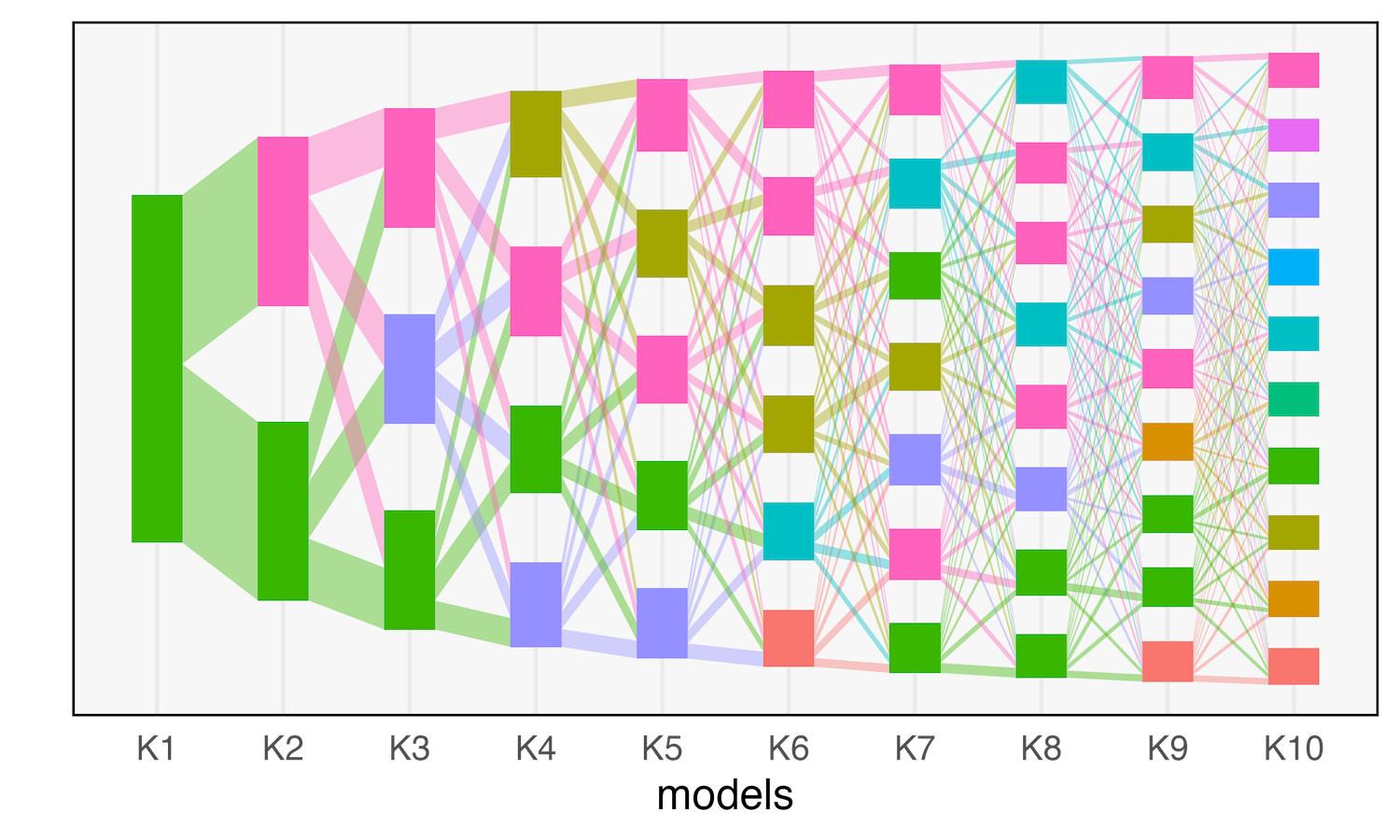
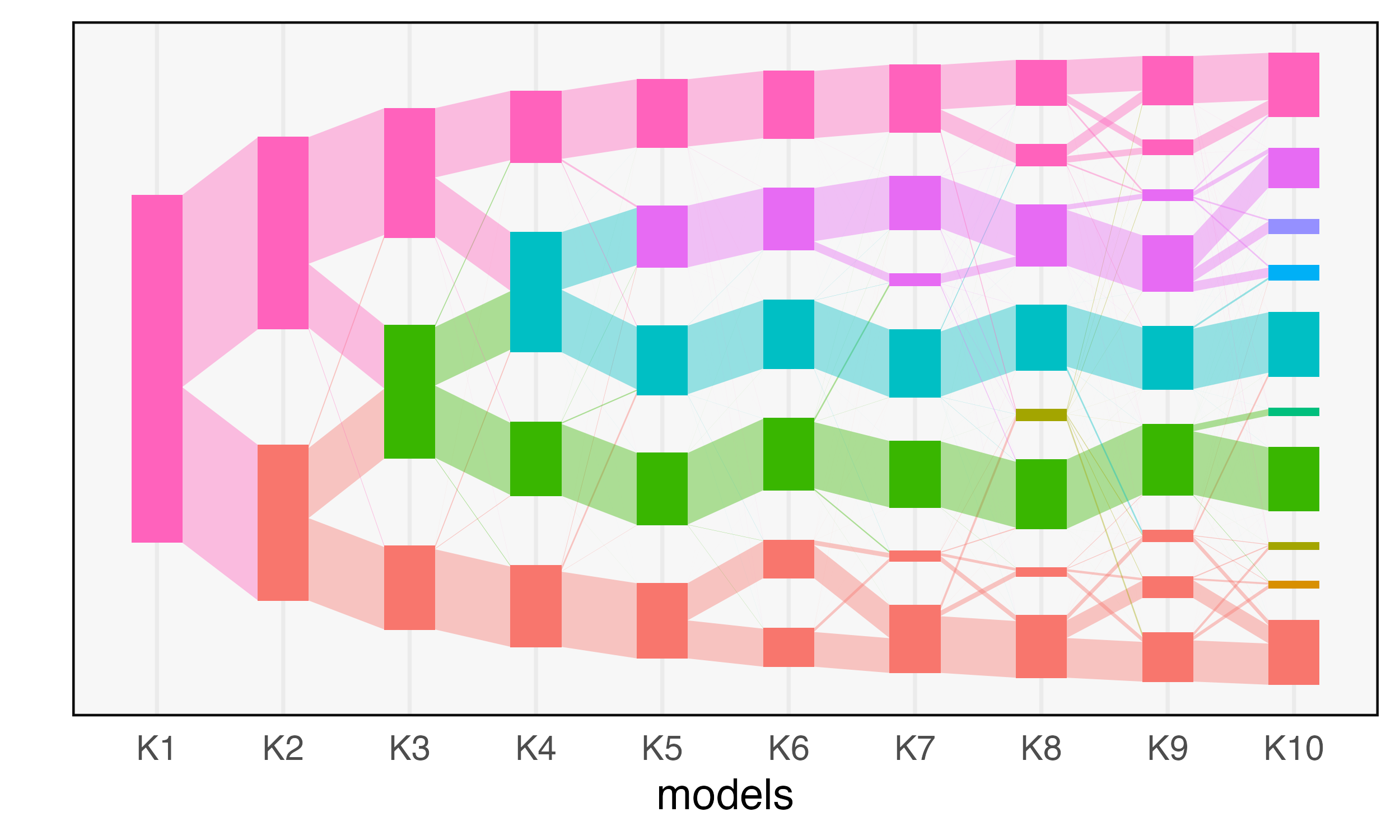
We fit models of varying complexity \(K\) and build a compact representation of the ensemble
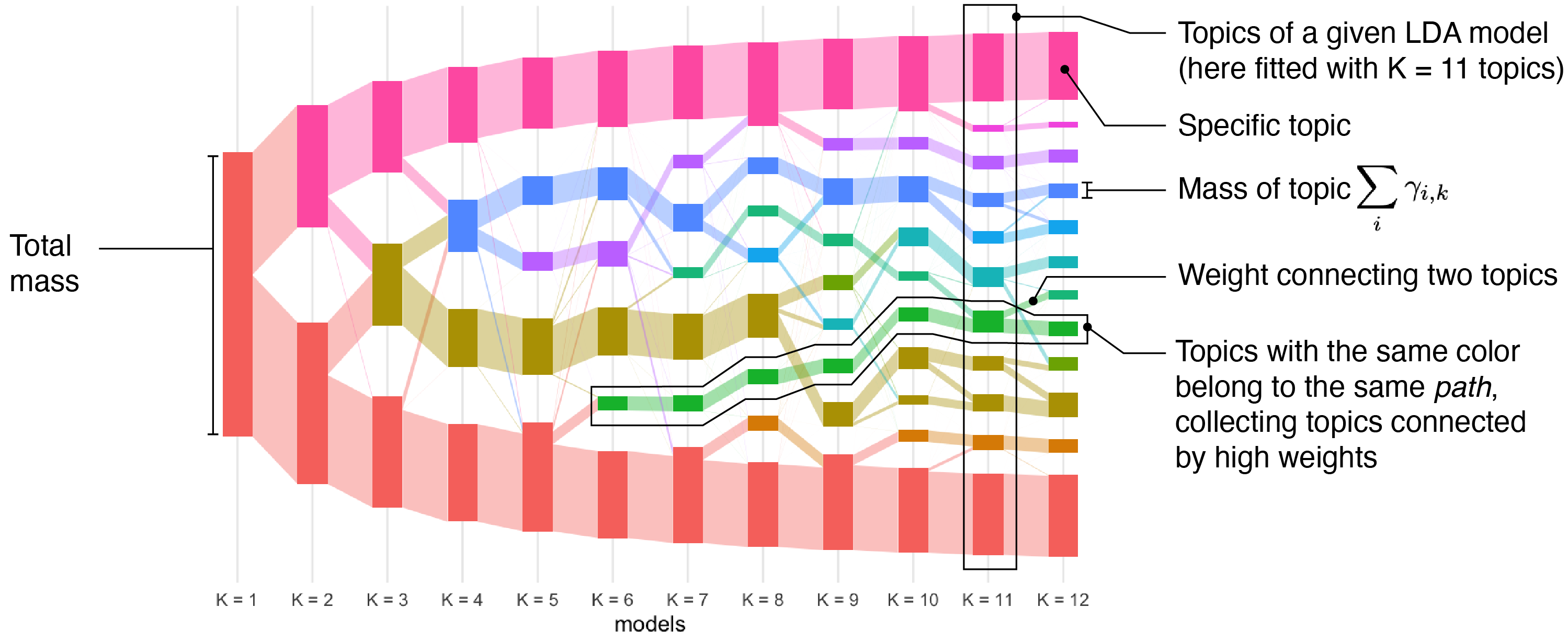
Columns are models and rectangles are topics.
Alignment as a Graph
An alignment is a graph where nodes \(V\) represent topics \(\beta\left(v\right) \in \Delta^D\) and memberships \(\Gamma\left(v\right) = \left(\gamma_{ik}^{m}\right)_{i=1}^{n} \in \reals^{N}\) across models.
- Edges \(E\) connect topics across complexities \(K \to K + 1\)
- Weights \(W\) measure topic similarity
Estimating Weights
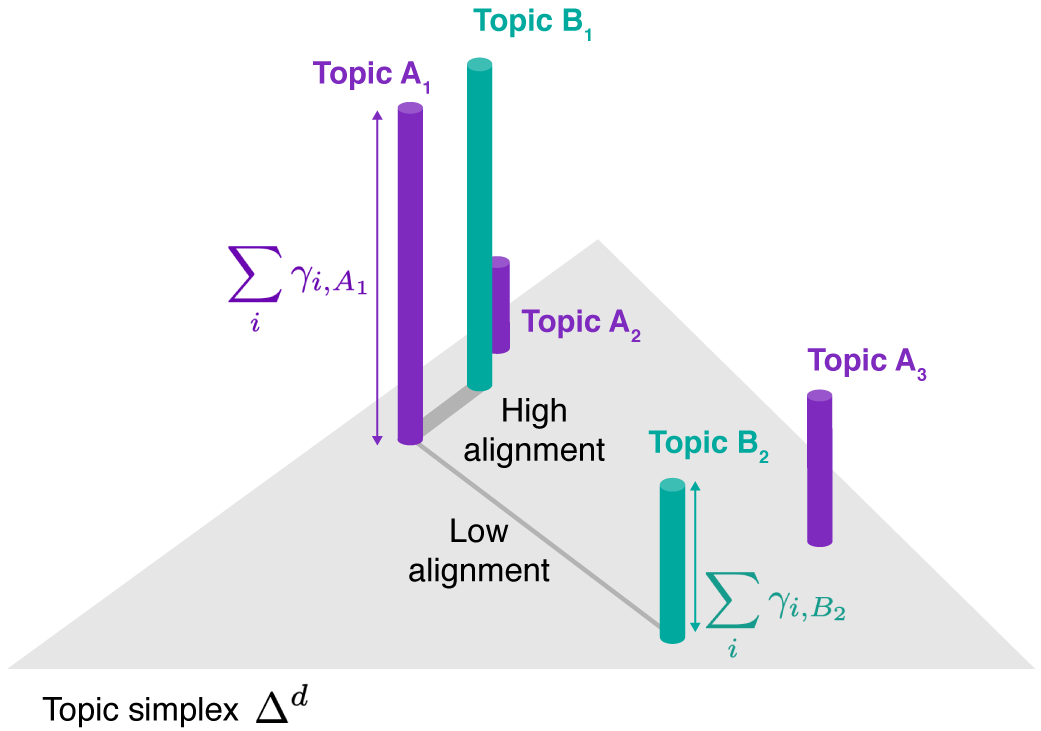
Let \(V_p\) and \(V_q\) be two subsets of topics within the graph.
- Let the total “mass” of \(V_p\) be \(p = \left\{\Gamma\left(v\right)^T 1 : v \in V_{p}\right\}\).
- Define the transport cost \(C\left(v, v^\prime\right) := JSD\left(\beta\left(v\right), \beta\left(v^\prime\right)\right)\), the Jensen-Shannon divergence between topics (Peyré and Cuturi 2018).
Estimating Weights
The weights \(W\) can be learned using optimal transport, \[\begin{align*} &\min_{W \in \mathcal{U}\left(p, q\right)} \left<C,W\right> \end{align*}\] \[\begin{align*} \mathcal{U}\left(p, q\right) := &\{W\in \mathbb{R}^{\left|V_{p}\right| \times \left|V_{q}\right|}_{+} : W 1_{\left|V_{q}\right|} = p \text{ and } W^{T} 1_{\left|V_{p}\right|} = q\}. \end{align*}\]
Path-based Diagnostics
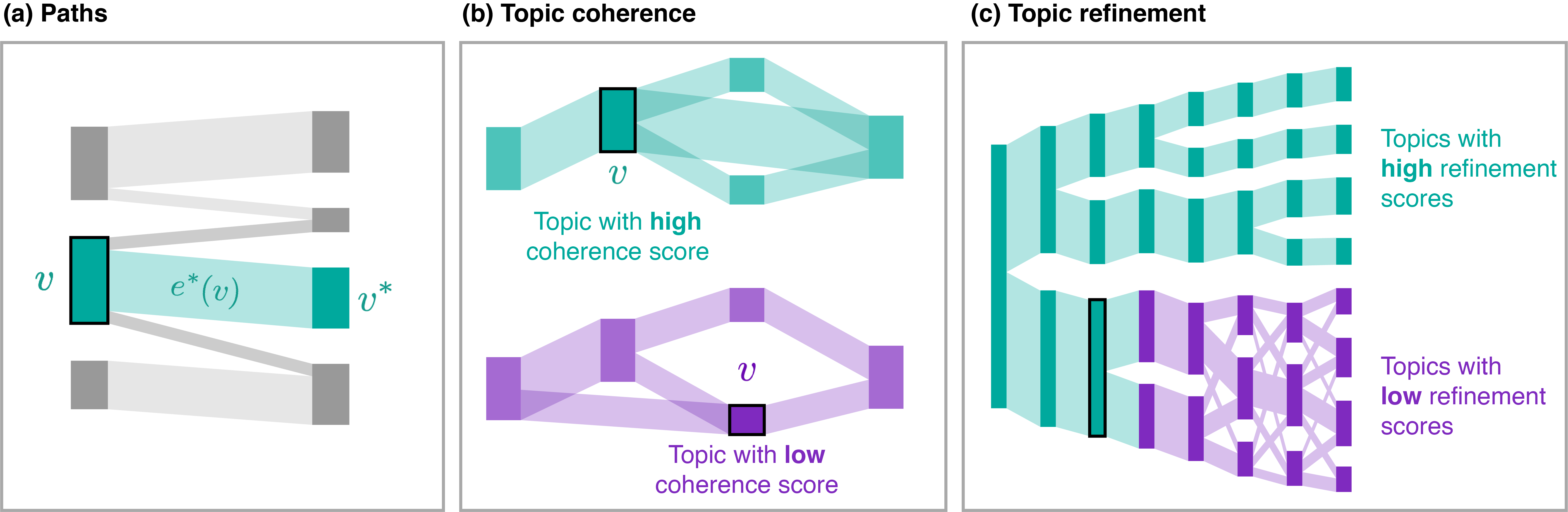
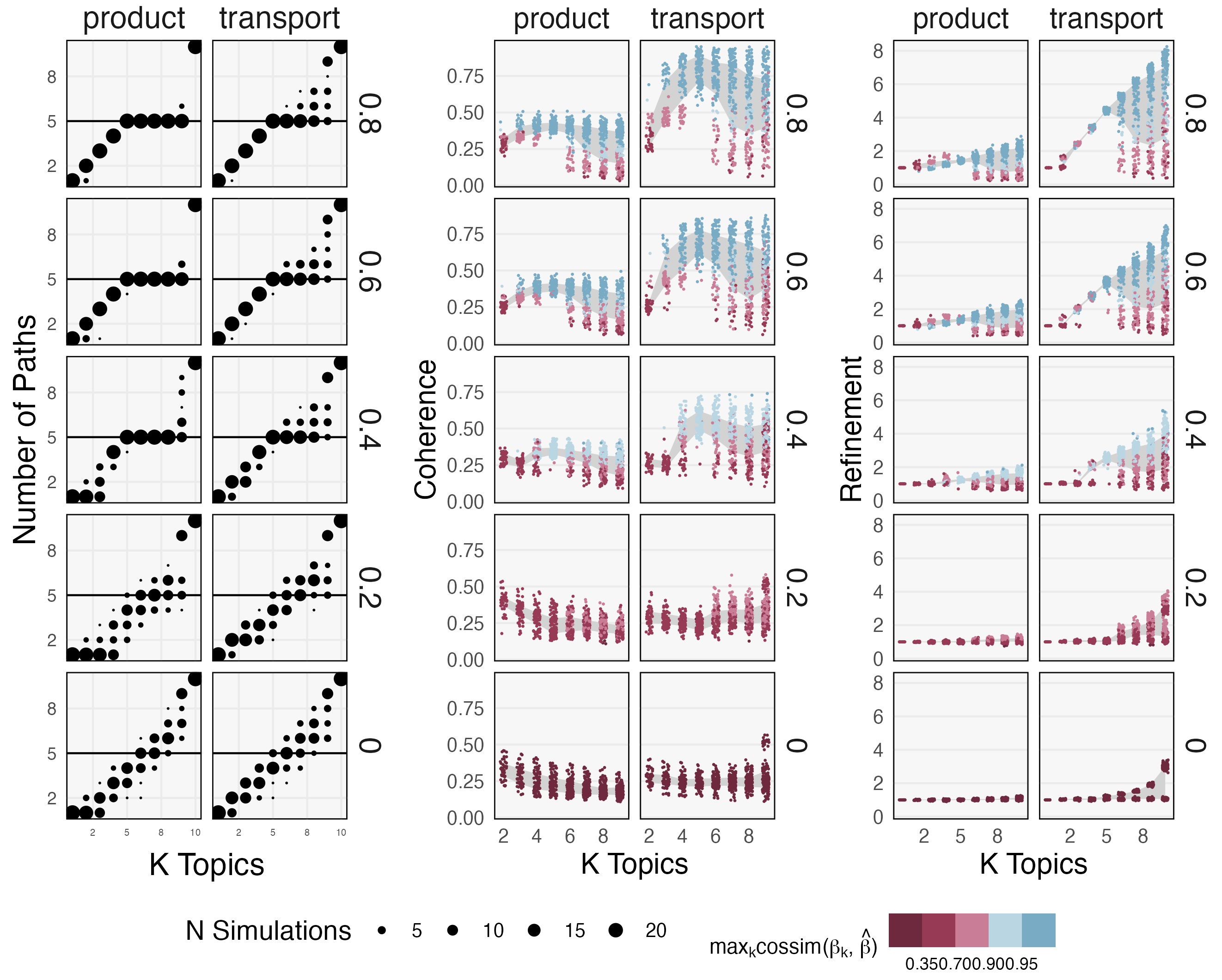
- Paths: Partitions the Sankey diagram into connected sets of topics.
- Coherence: Average similarity of \(\beta\left(v\right)\) to other topics along the same a path. High coherence \(\to\) persistent structure.
- Refinement: Mixing between descendants. High refinement \(\to\) genuine increase in complexity.
Examples: True Model
Below is the alignment for data from a topic model. Can you guess \(K\)?
- \(N = 250, D = 1000, \lambda_{\gamma} = 0.5, \lambda_{\beta} = 0.1\)
Examples: True Model
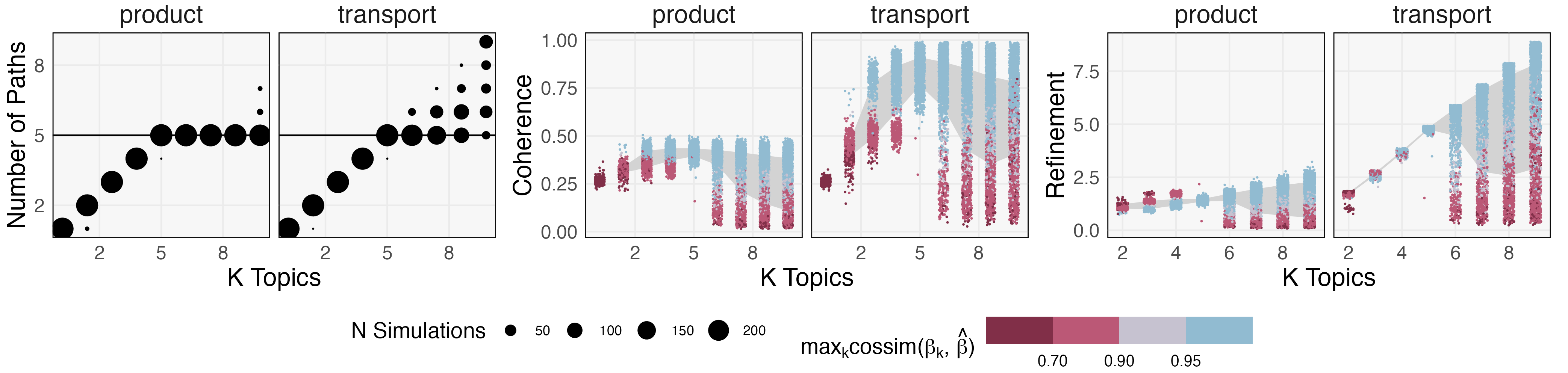
The diagnostics suggest that the true \(K\) is 5.
Data Analysis Background
(Ravel et al. 2010) used clustering to identify 5 Community State Types in the vaginal microbiome.
Four healthy CSTs are dominated by Lactobacillus variants.
A fifth CST is more diverse and is associated with preterm birth (Fettweis et al. 2019; Gudnadottir et al. 2022) and HIV transmission (Gosmann et al. 2017).
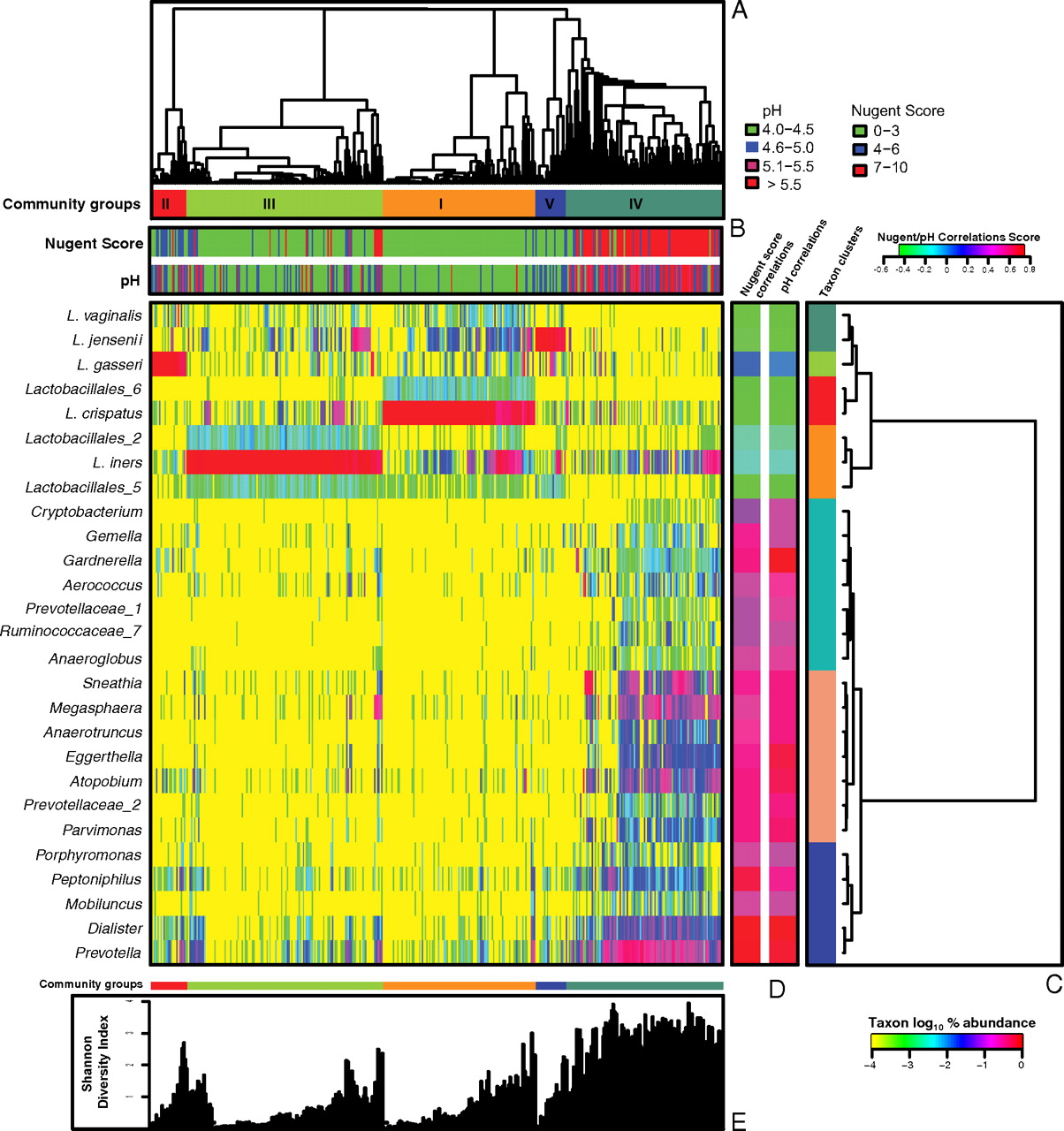
(Ravel et al. 2010) grouped samples (columns) into CSTs.
Deconstructing CSTs
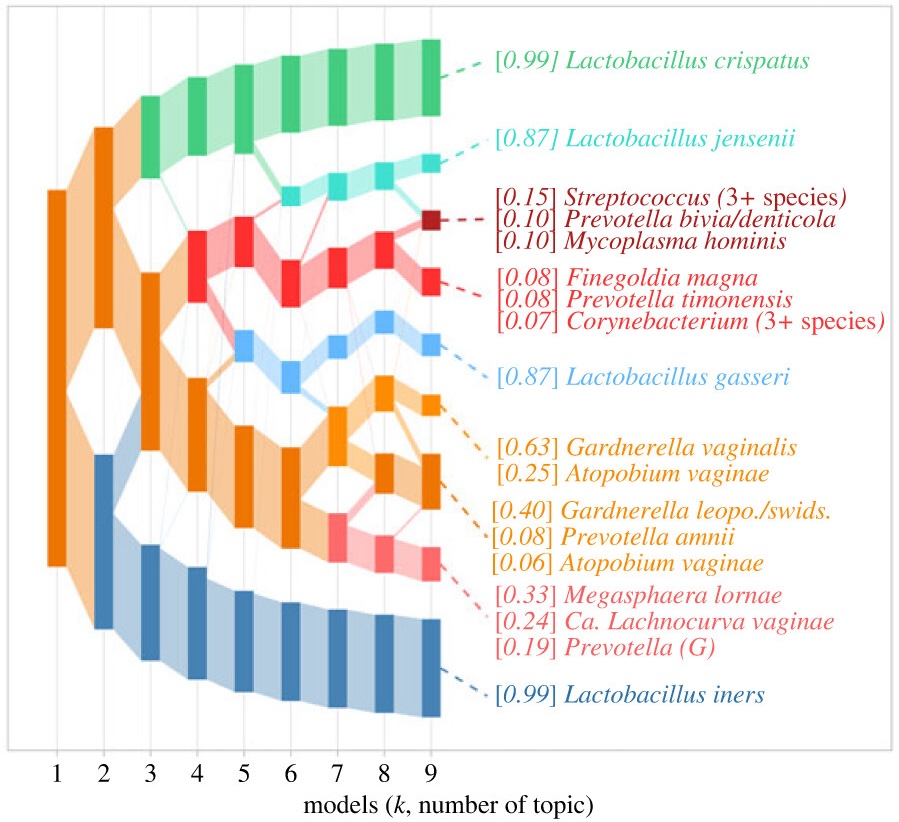
The follow-up study (Symul et al. 2023) had more samples than (Ravel et al. 2010) and so could identify additional structure lying behind CSTs.
- They had 2179 samples from 135 women, sampled longitudinally.
- The green and blue paths to the right reflect the known Lactobacillus CSTs.
Coherence Scores
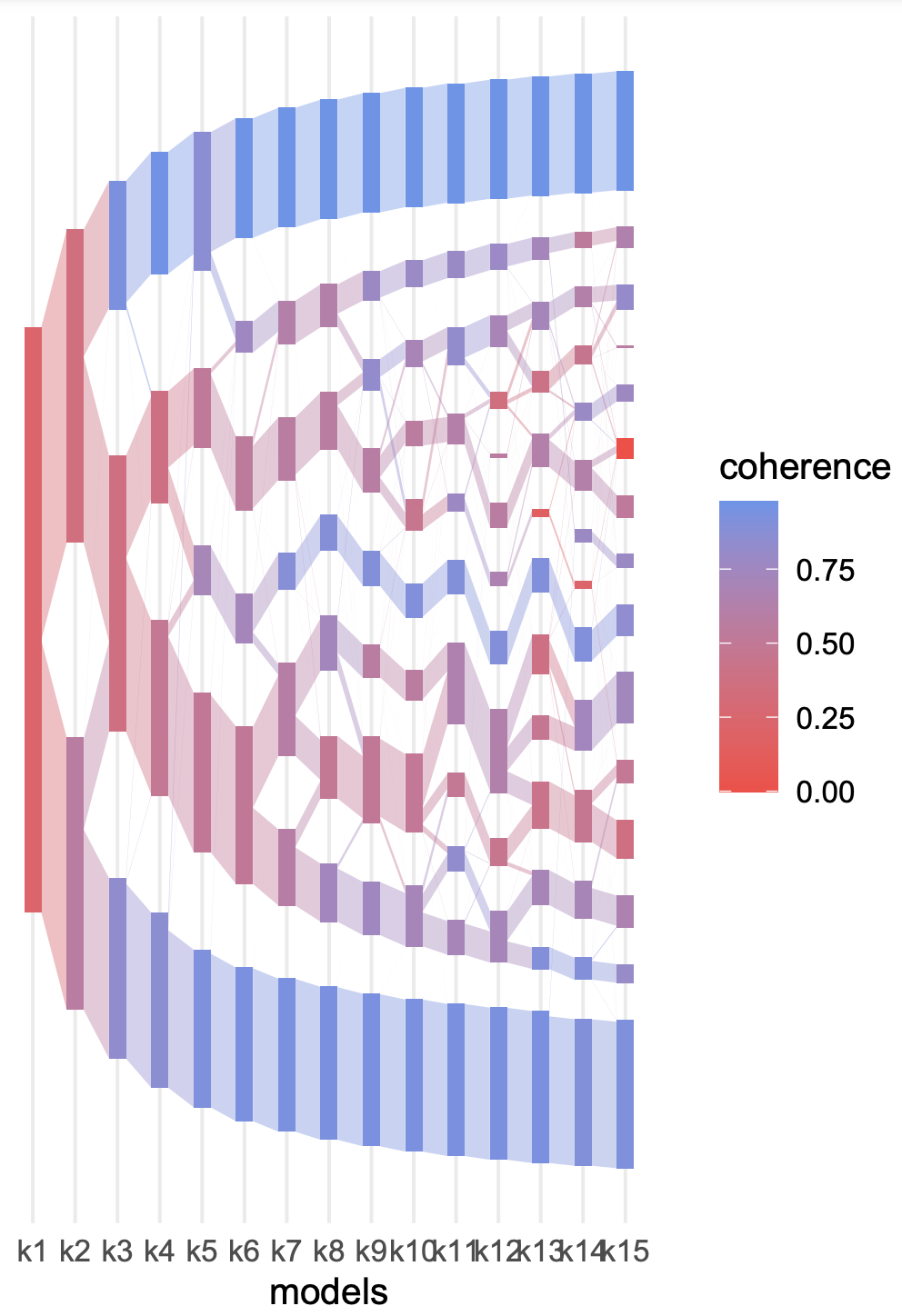
Coherence is not a function of \(K\) alone.
Software
Topic alignment is implemented in the R package alto.
All the simulations discussed today are vignettes in the package.
Distortions in \(t\)-SNE and UMAP
Both \(t\)-SNE and UMAP introduce distortions. For example, they may not preserve density within different regions of the plot.
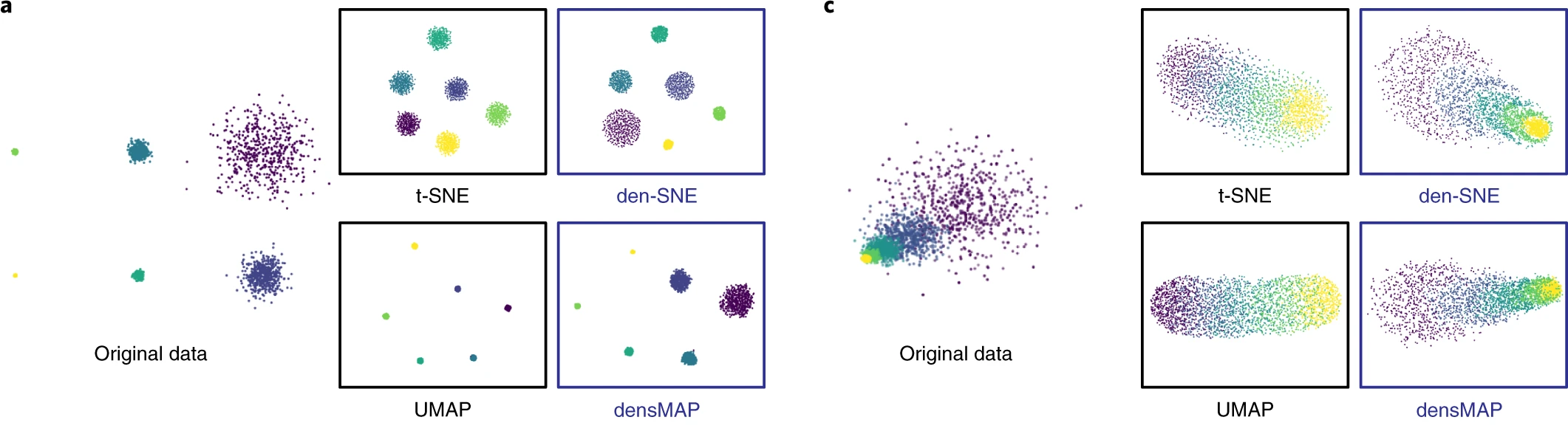
Example from (Narayan, Berger, and Cho 2021).
Distortions in \(t\)-SNE and UMAP
They can also fail to preserve the topology of the underlying data…
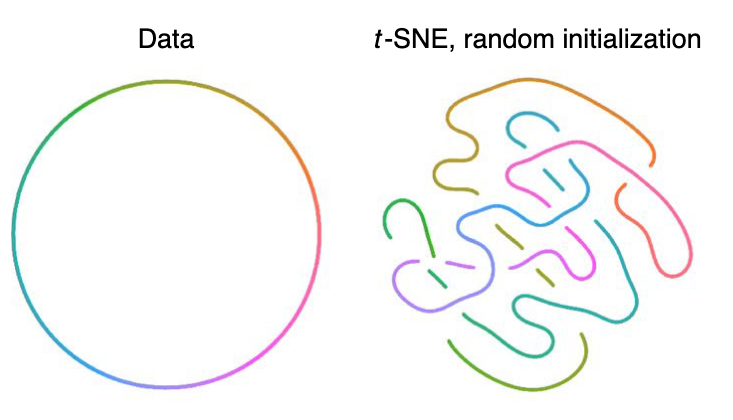
Example from (Kobak and Linderman 2021).
Consequences
These distortions are not mere technical curiosities – they significantly impact scientific interpretation (Liu, Ma, and Zhong 2025; Kobak and Linderman 2021). For example, they create misleading differences between cell types that are actually similar.
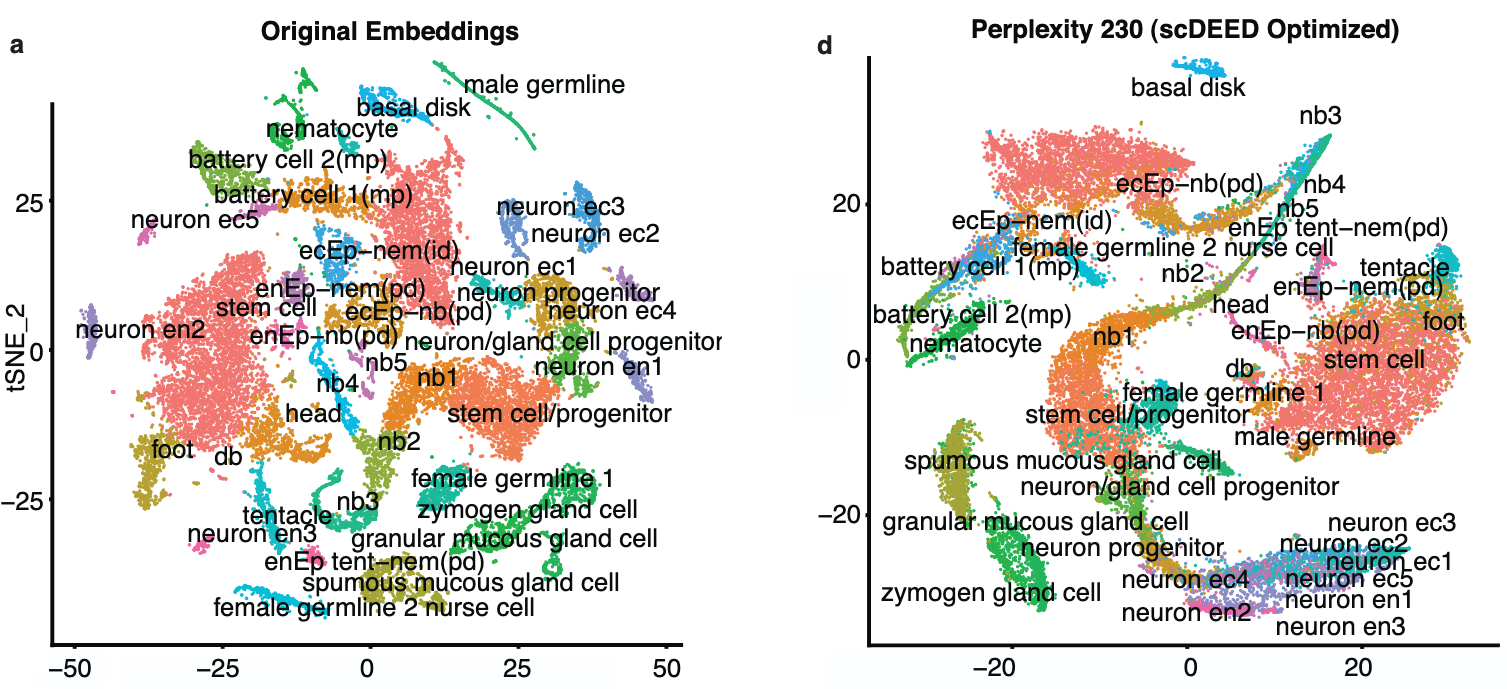 Example from (Xia, Lee, and Li 2024).
Controversy
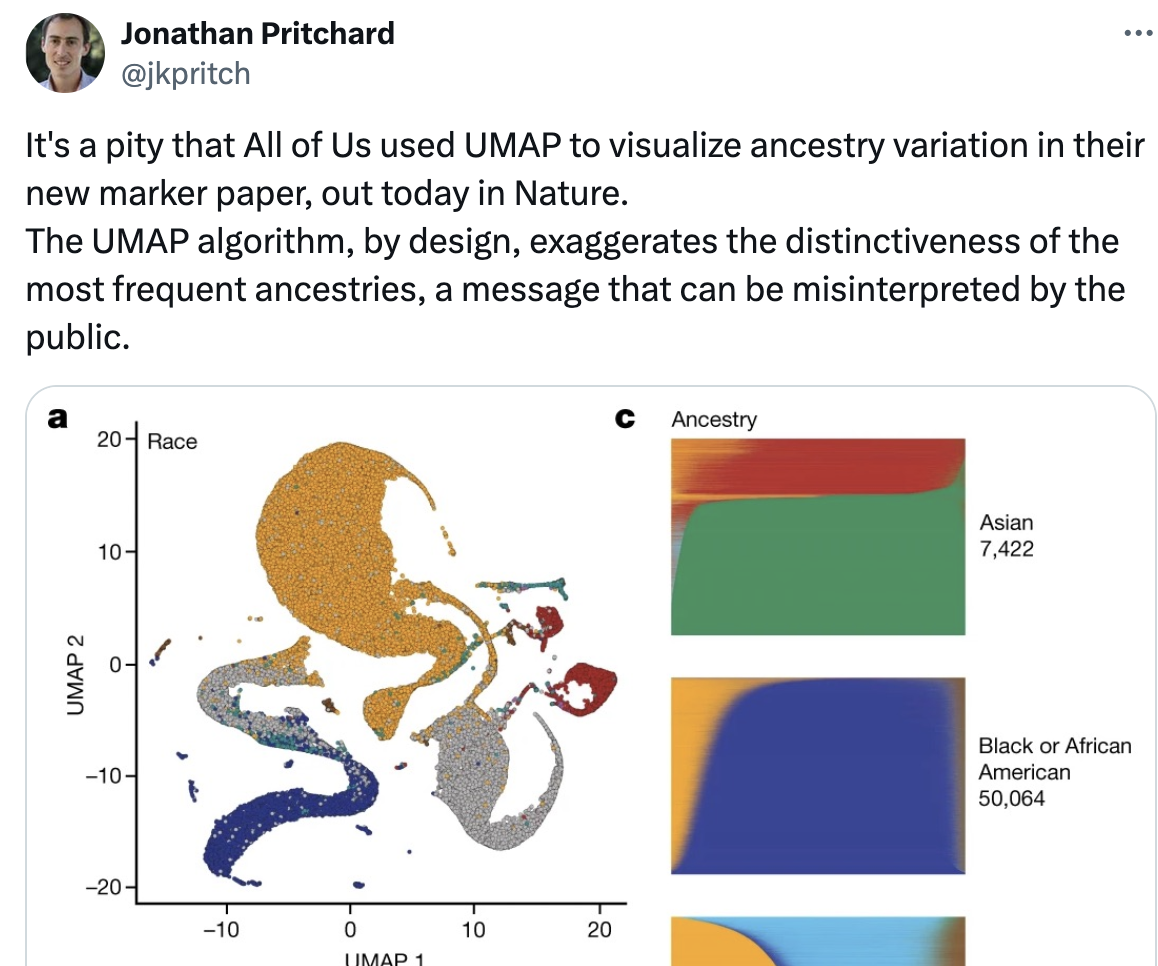
See also (Kozlov 2024; Irizarry 2024).
Approach
Rather than abandoning nonlinear dimensionality reduction, we augment the embeddings to characterize distortion.
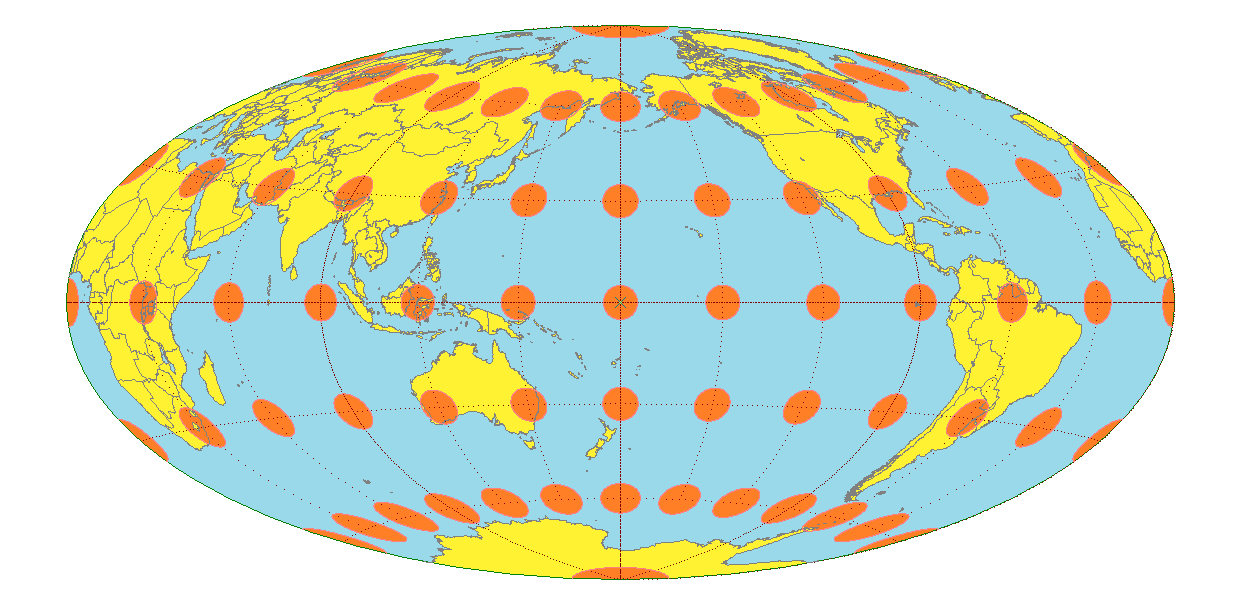
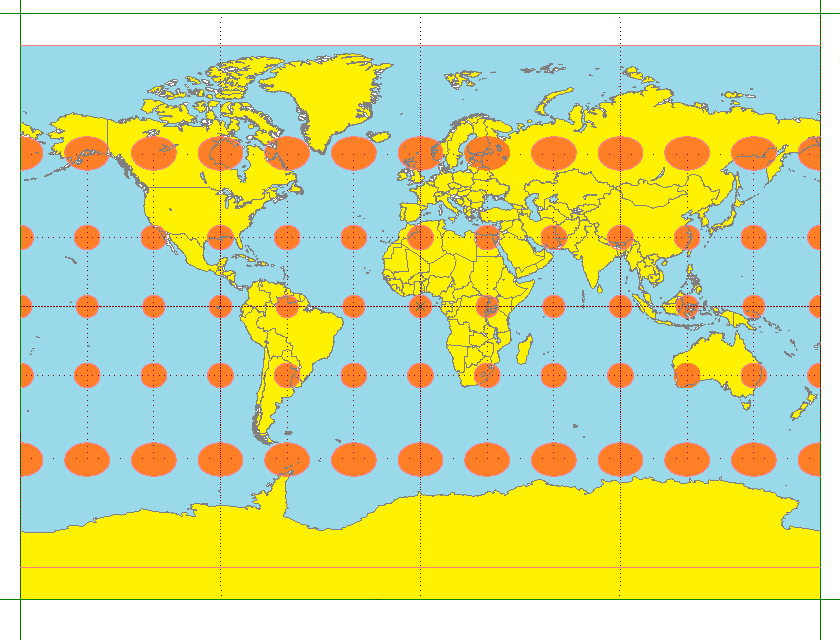
This is a high-dimensional version of Tissot’s indicatrix from cartography (Laskowski 1989).
RMetric Motivation
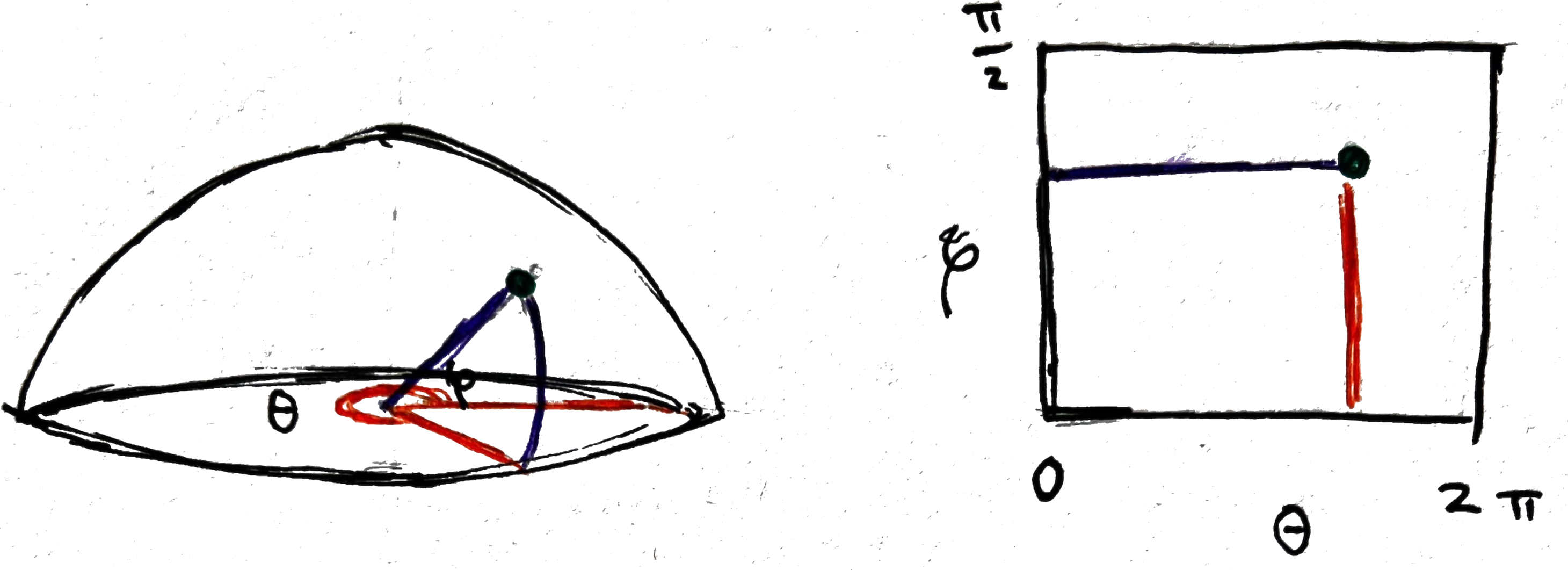
The RMetric algorithm (Perrault-Joncas and Meila 2006; McQueen et al. 2016) quantifies distortion geometrically. To motivate the algorithm, consider the distortion induced by mapping the sphere into latitude/longitude coordinates.
Half-Sphere Parameterization
Parameterize points on \(\mathcal{M}\) using spherical coordinates:
\[\begin{align*} \mathbf{x}\left(p\right) = \left(\cos\varphi\cos\theta, \cos\varphi \sin\theta, \sin\varphi\right) \end{align*}\]
The associated (latitude, longitude) embedding is
\[\begin{align*} \mathbf{z}\left(p\right) = \left(\theta\left(p\right), \varphi\left(p\right)\right). \end{align*}\]
Pushforward Metric
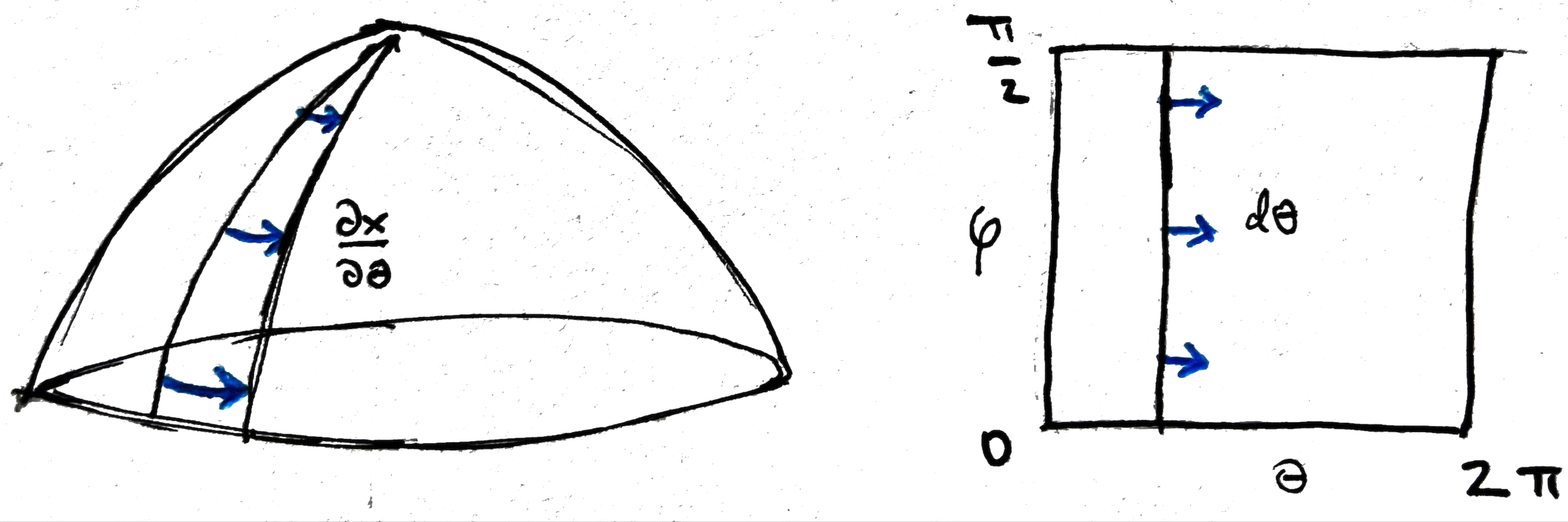
What does a small step in the embedding space correspond to in \(\mathcal{M}\)? The pushforward metric answers this,
\[\begin{align*} g_{ij} = \left\langle \frac{\partial\mathbf{x}}{\partial z^i}, \frac{\partial\mathbf{x}}{\partial z^j}\right\rangle_{\mathbb{R}^3} \end{align*}\]
This varies across \(p \in \mathcal{M}\) but we suppress it from the notation.
Pushforward Metric
In the sphere example, these derivatives can be directly computed and to obtain,
\[\begin{align*} G = \begin{pmatrix} \cos^2\varphi & 0 \\ 0 & 1 \end{pmatrix} \end{align*}\] Near the equator (\(\varphi \approx 0\)), a small step in \(\theta\) covers more distance than near the north pole (\(\varphi \approx \frac{\pi}{2}\)).
Dual Pushforward Metric
Alternatively, the gradients \(\nabla z^i\) of the embedding dimensions also reflect distortion.
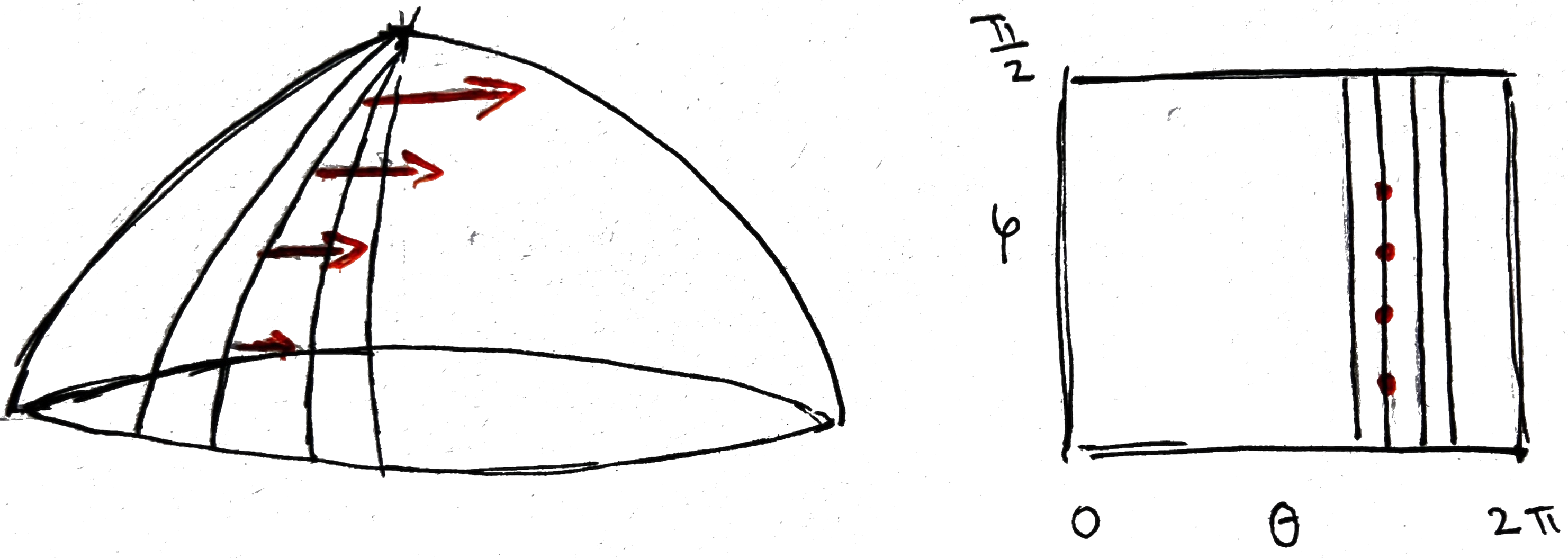
Since the level sets of \(z^\theta\) become more compressed near the poles, the gradients \(\nabla z^\theta\) become larger there.
Implementation
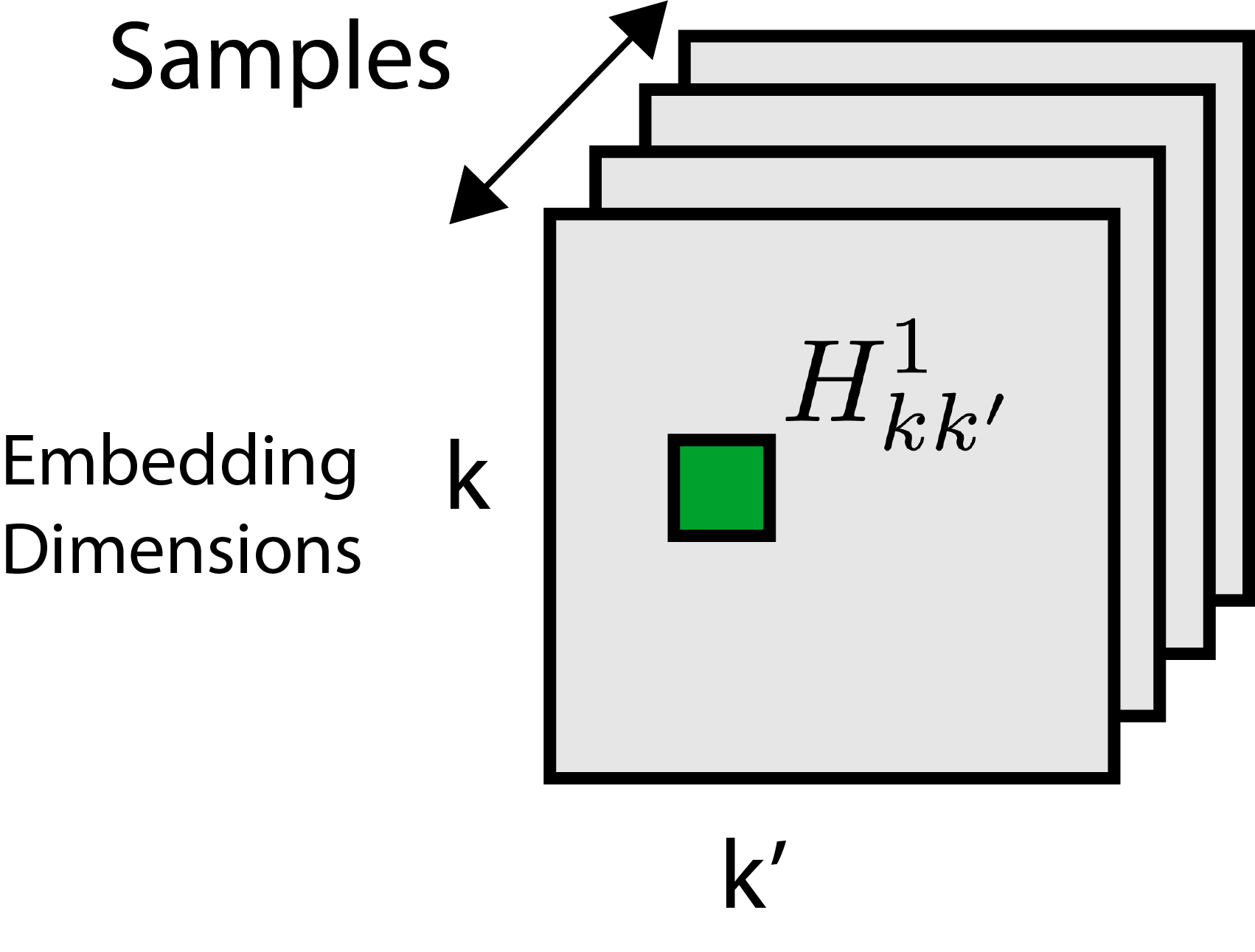
Let \(z_{k} \in \mathbb{R}^{N}\) be the \(k^{th}\) embedding dimension. Let \(L\) be the doubly-normalized graph Laplacian (Coifman and Lafon 2006). Compute
\[\begin{align*} H_{kk'}^{(\cdot)} := \frac{1}{2}\left[L\left(z_{k} \circ z_{k'}\right) - z_{k} \circ \left(L z_{k'}\right) - z_{k'} \circ \left(L z_{k}\right) \right] \in \mathbb{R}^{N} \end{align*}\]
The embedding distortion for sample \(n\) is given by \(H^{(n)} \in \mathbb{R}^{K \times K}\)
Example
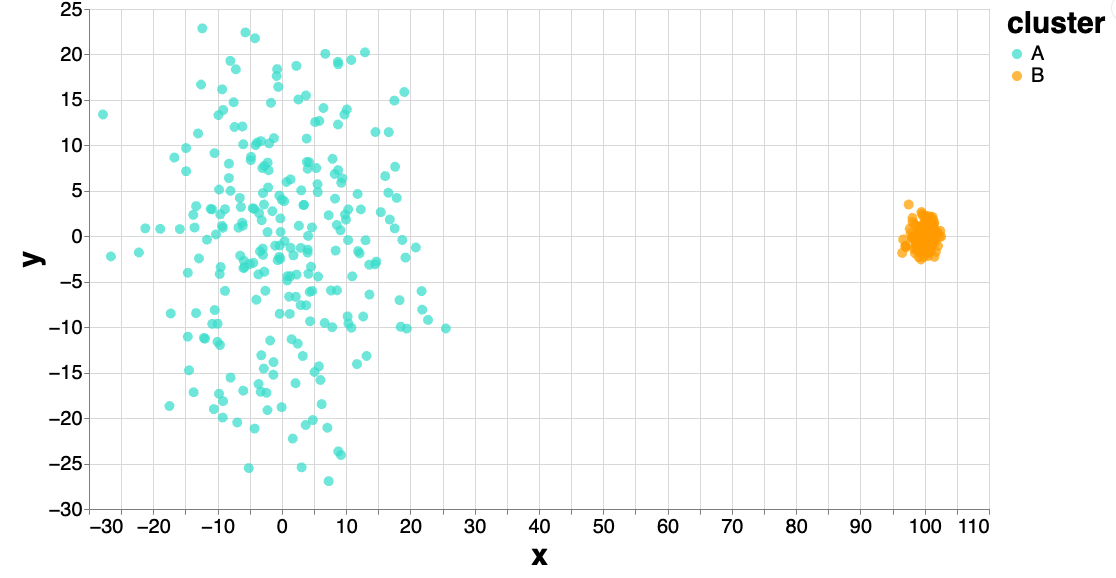
These two clusters are generated as:
\[\begin{align*} x_{i} \sim \frac{1}{2}\mathcal{N}\left(0, 10\right) + \frac{1}{2}\mathcal{N}\left(100, 1\right) \end{align*}\]
Example
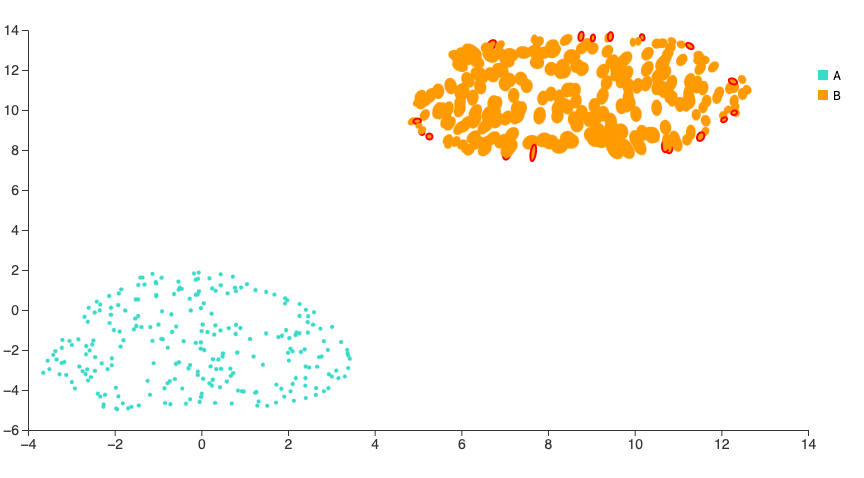
The UMAP embeddings lose information about the cluster density, but the difference is captured in the local metrics.
Local Isometrization
Since the metrics are known locally, the distortion can be inverted within a neighborhood of the cursor. For example, here we interactively adapt the embeddings in the Gaussian mixtures example.
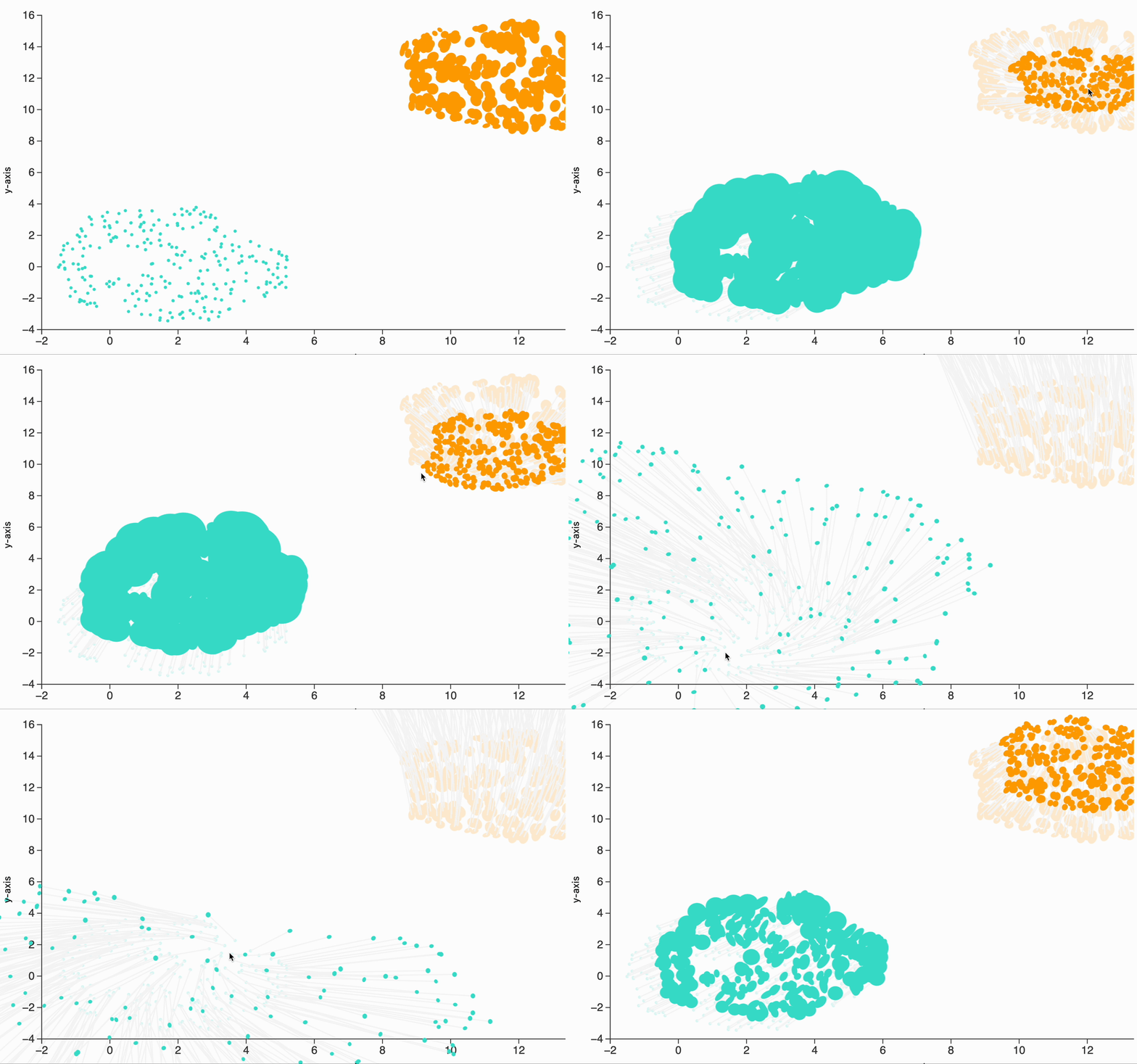
Fragmented Neighborhoods
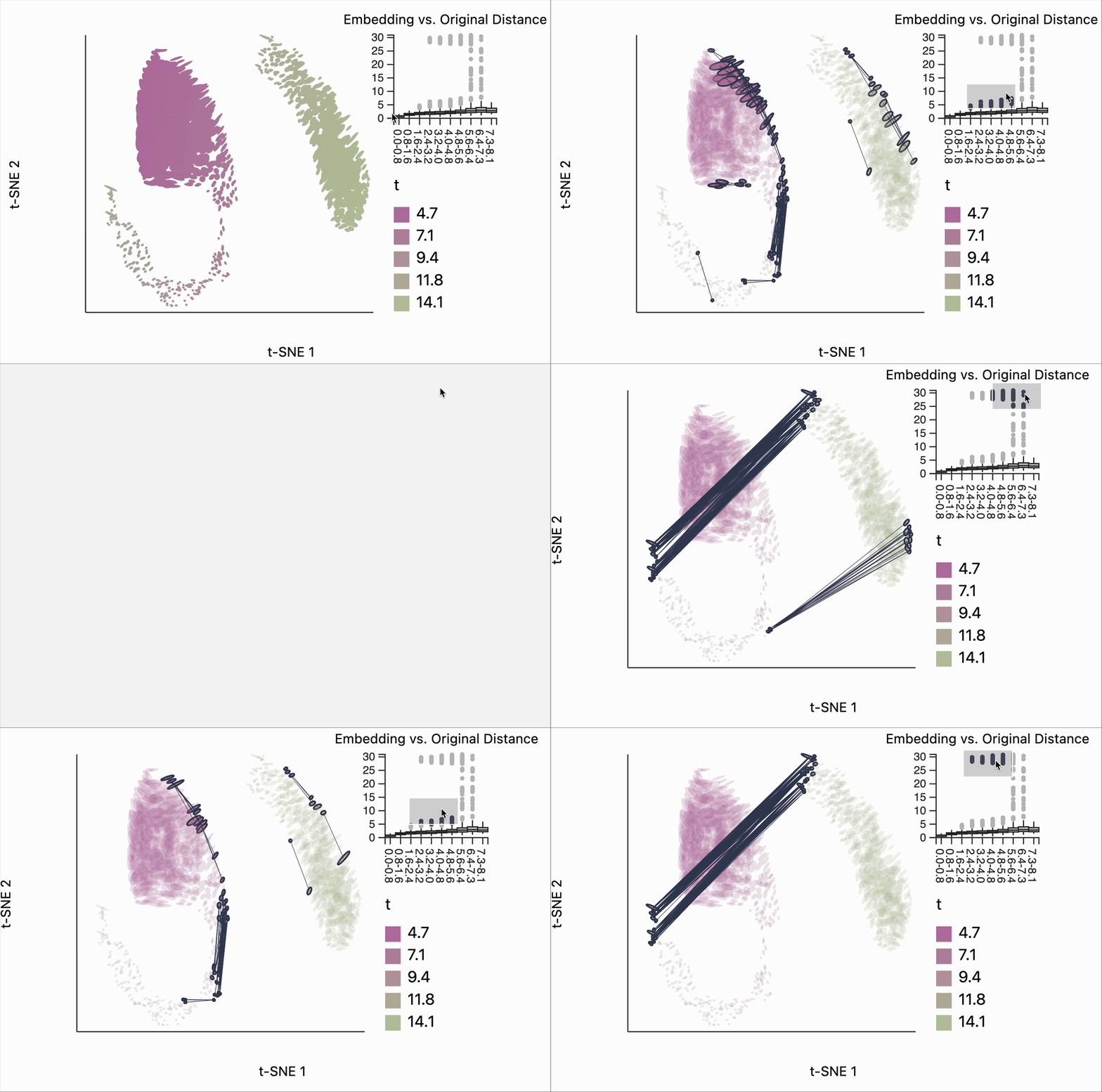
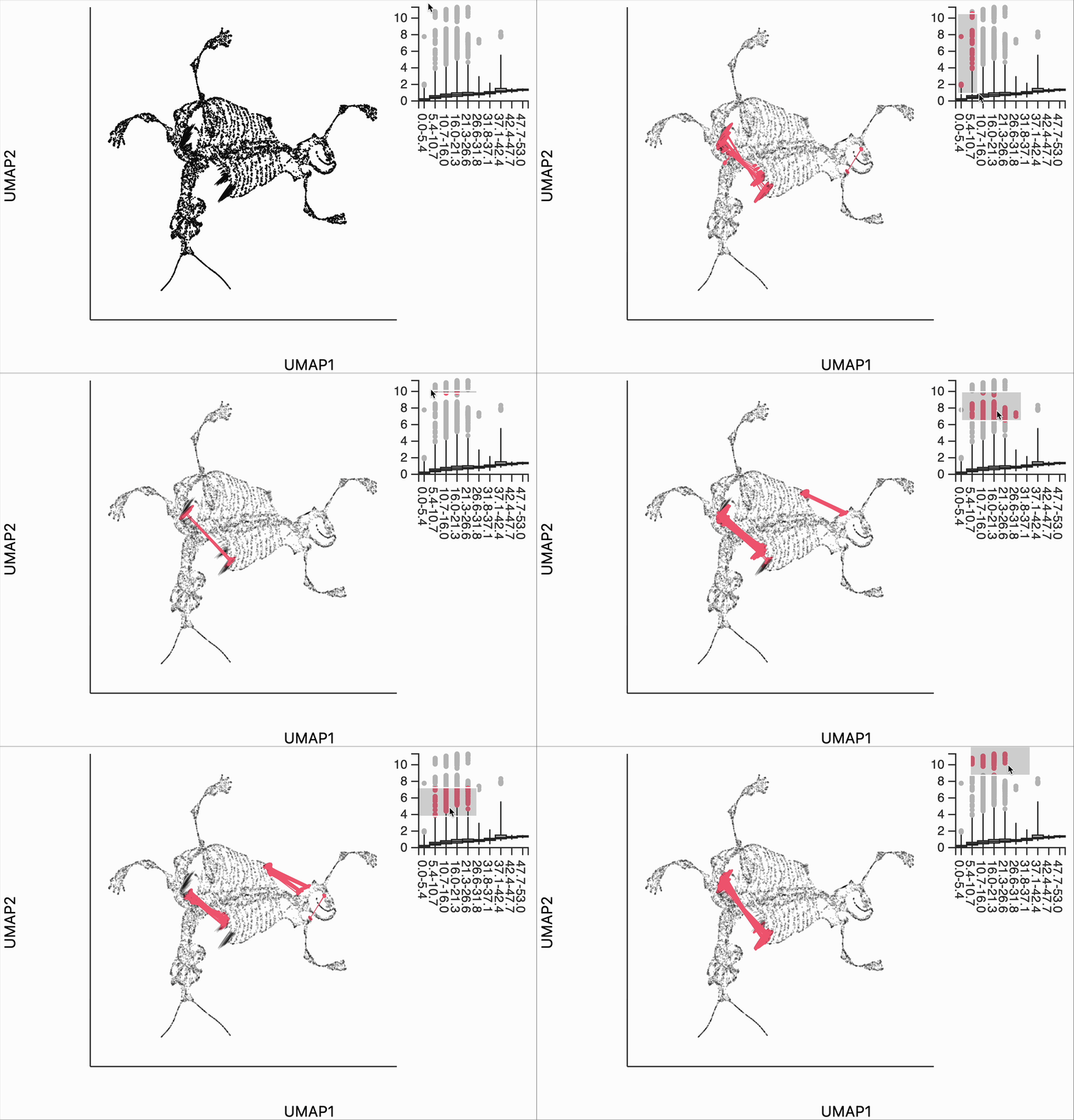
Besides RMetric, we also visualize distortions using the scatterplot of true vs. embedding neighborhood distances.
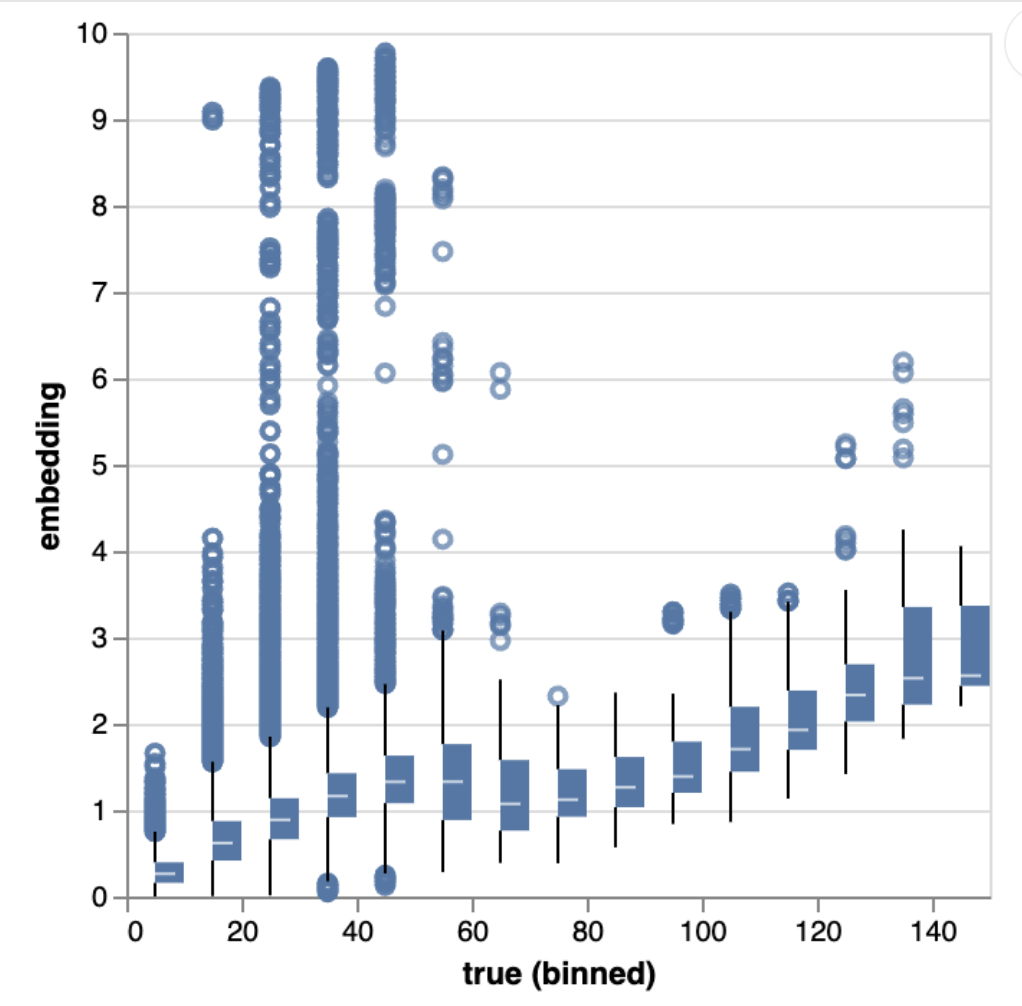
Fragmented Neighborhoods
To detect poorly preserved neighborhoods, we fit a running median to true vs. embedding distances, flag outliers above \(3\times \text{IQR}\), and mark points with many outlier links as “broken.”
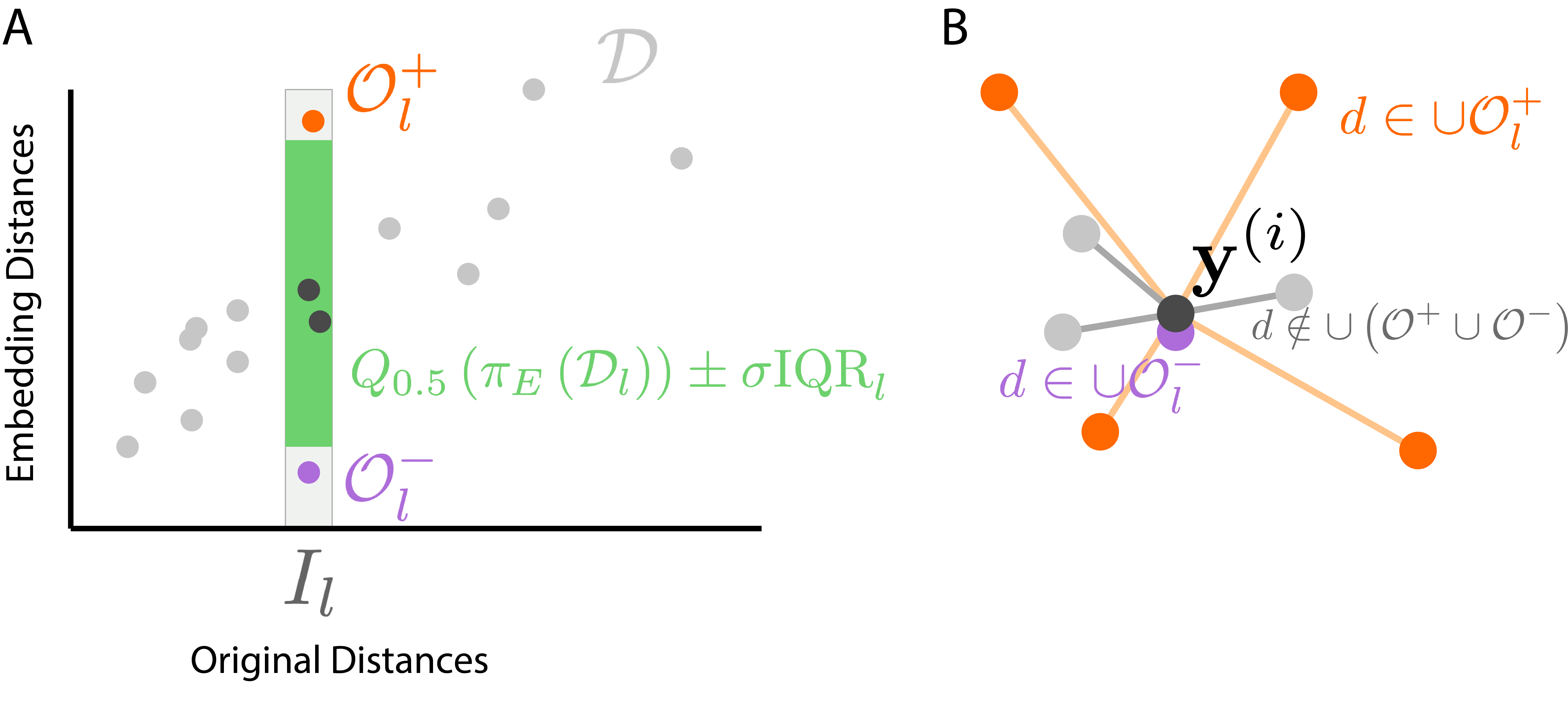
Variable Density Swiss Roll
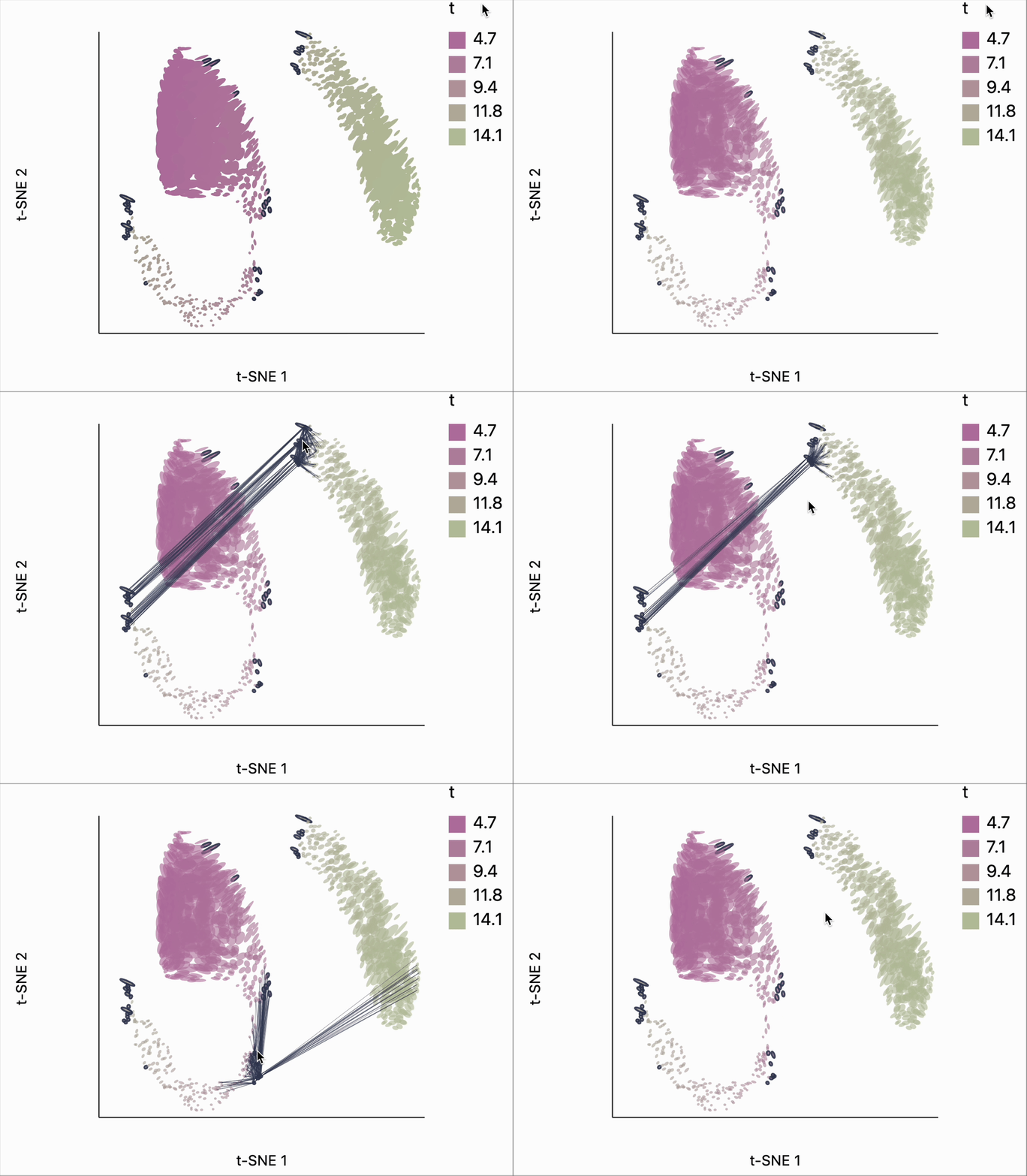
\(t\)-SNE (perplexity = 100) breaks the roll in the low-density region and artificially spreads the high density area.
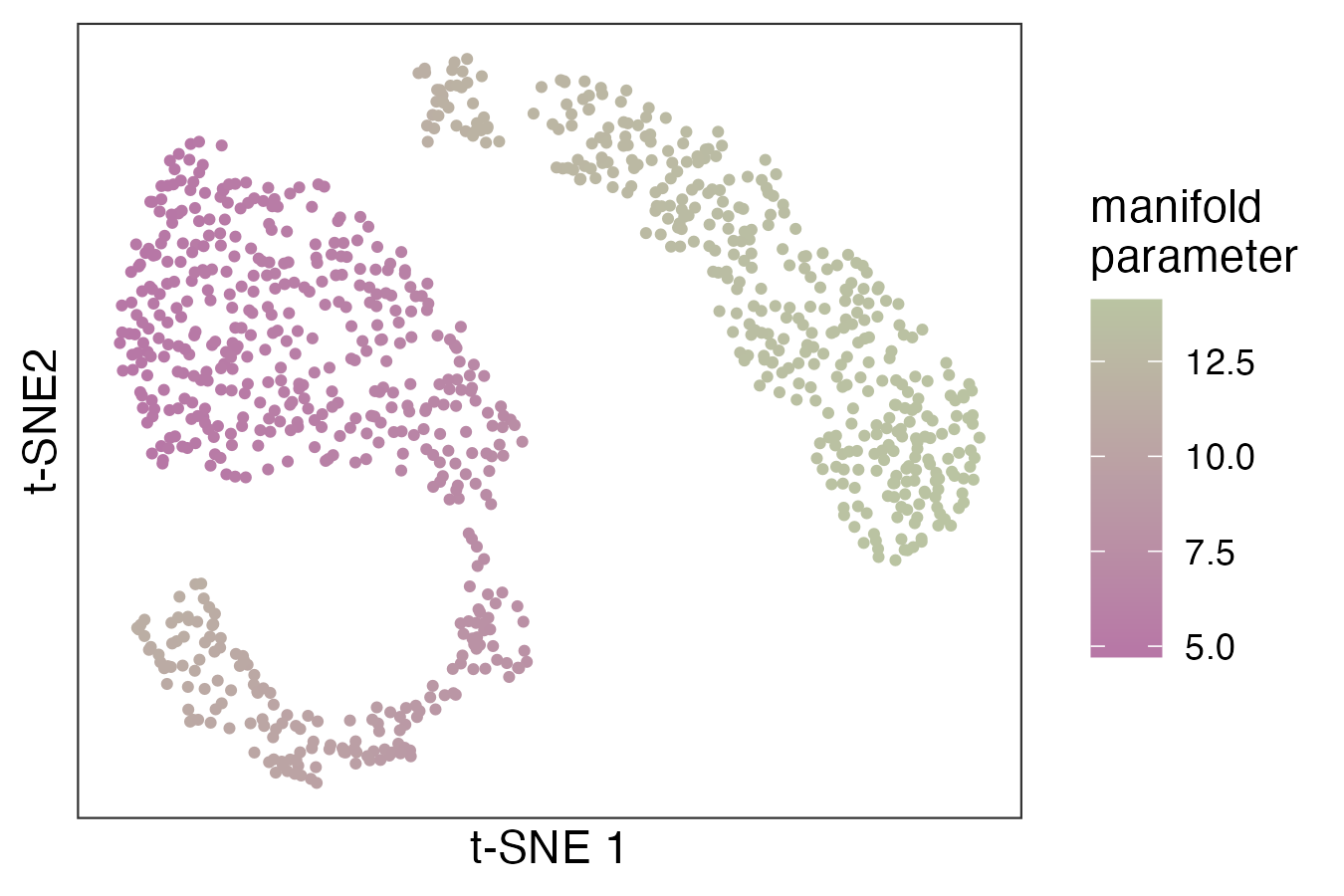
Fragmented Neighborhoods
Poorly Preserved Distances
PBMC Dataset
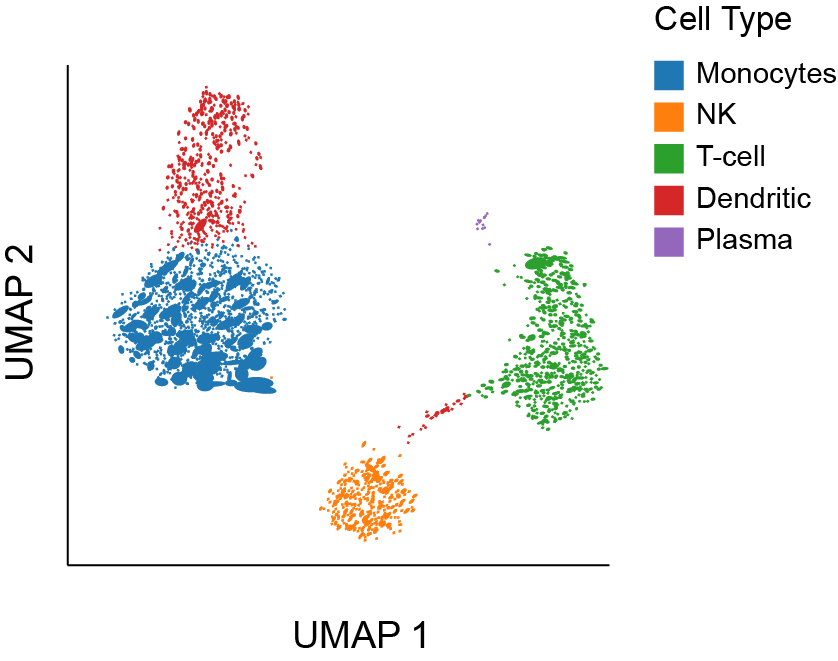
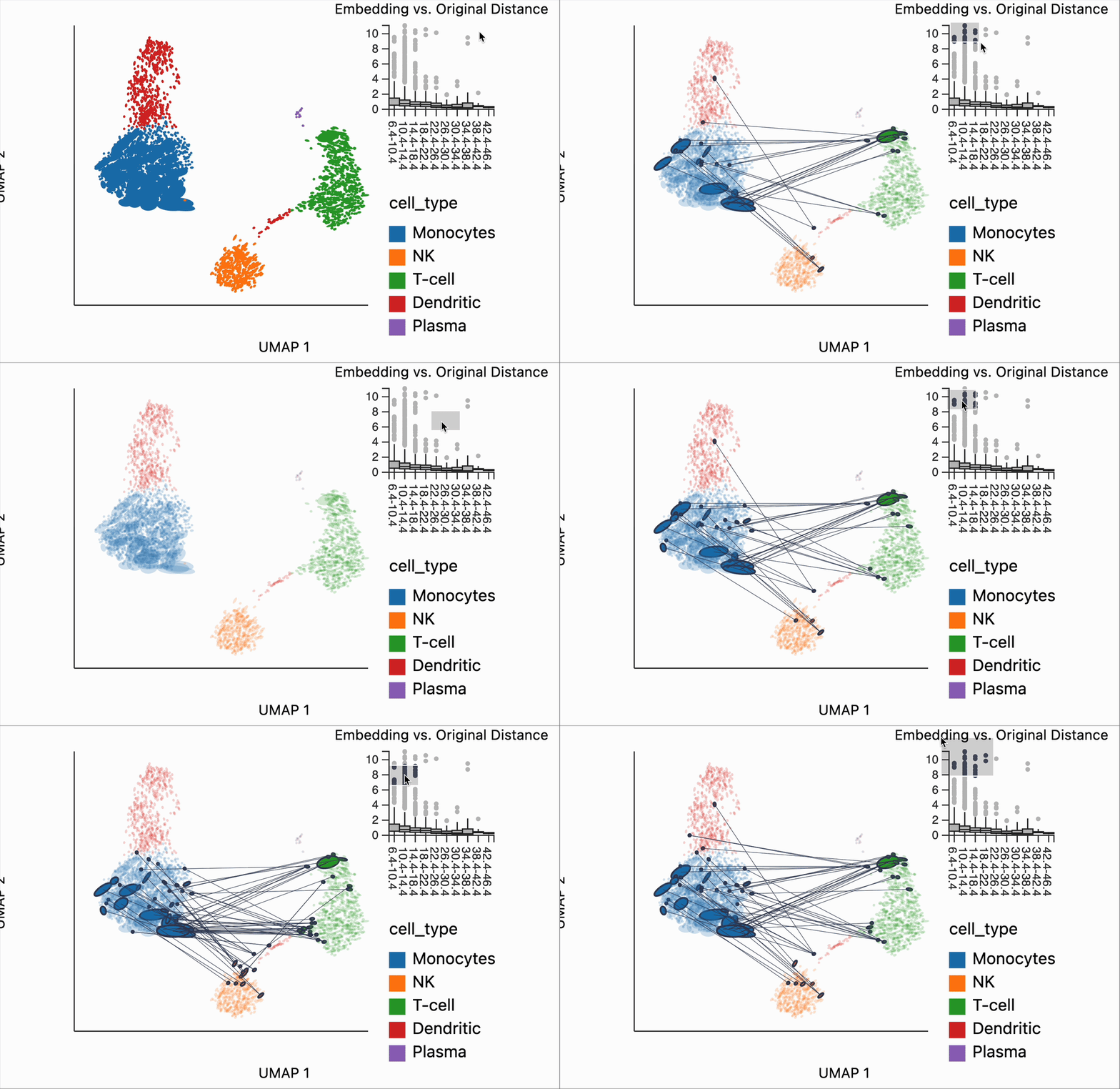
This single-cell gene expression data set was used in the data visualization tutorial from the scanpy package (Wolf, Angerer, and Theis 2018). Each point is the UMAP embedding of a cell’s high-dimensional gene expression data.
PBMC Dataset
- Distance scales vary both across and within clusters.
- Two T-cell sets appear farther from Monocytes than they actually are.
Hydra Cell Atlas
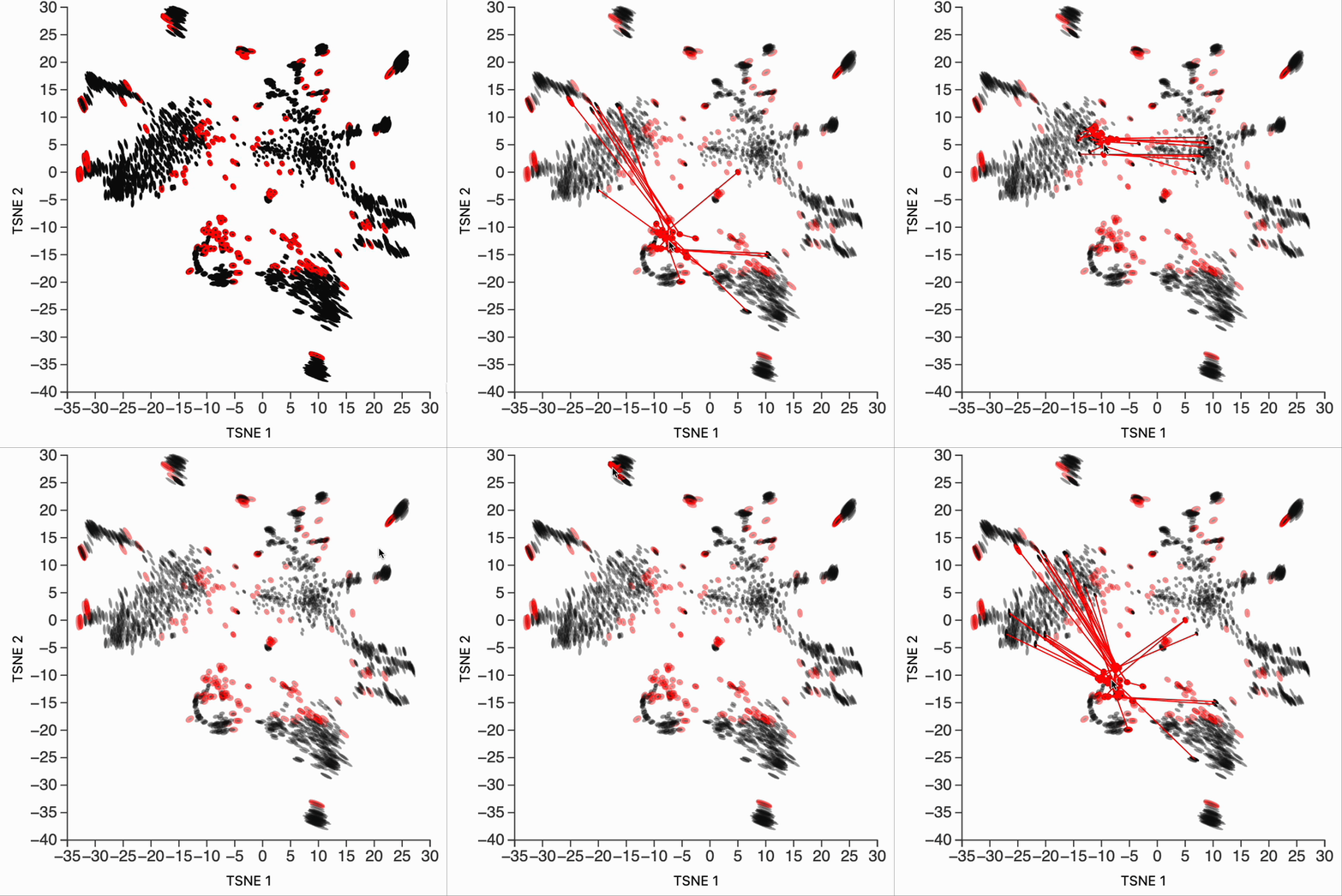
In this hydra cell differentiation dataset (Siebert et al. 2019; Xia, Lee, and Li 2024), \(t\)-SNE (perplexity = 80) collapses points along the dataset periphery and exaggerates between-cluster distances
Hydra Cell Atlas
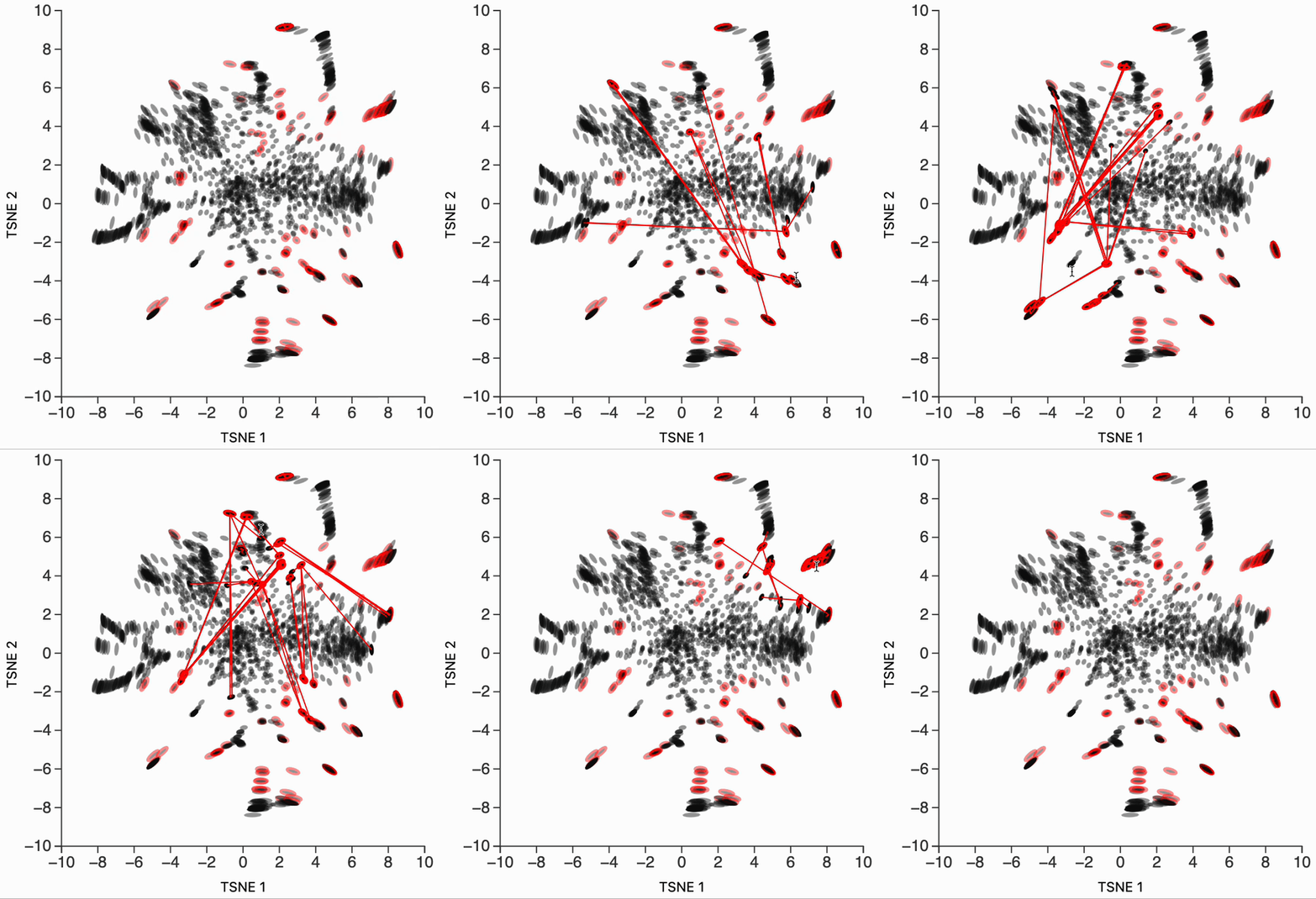
At perplexity = 500, the clusters are more reliable, but peripheral samples are in fact closer than they appear
Hydra Cell Atlas
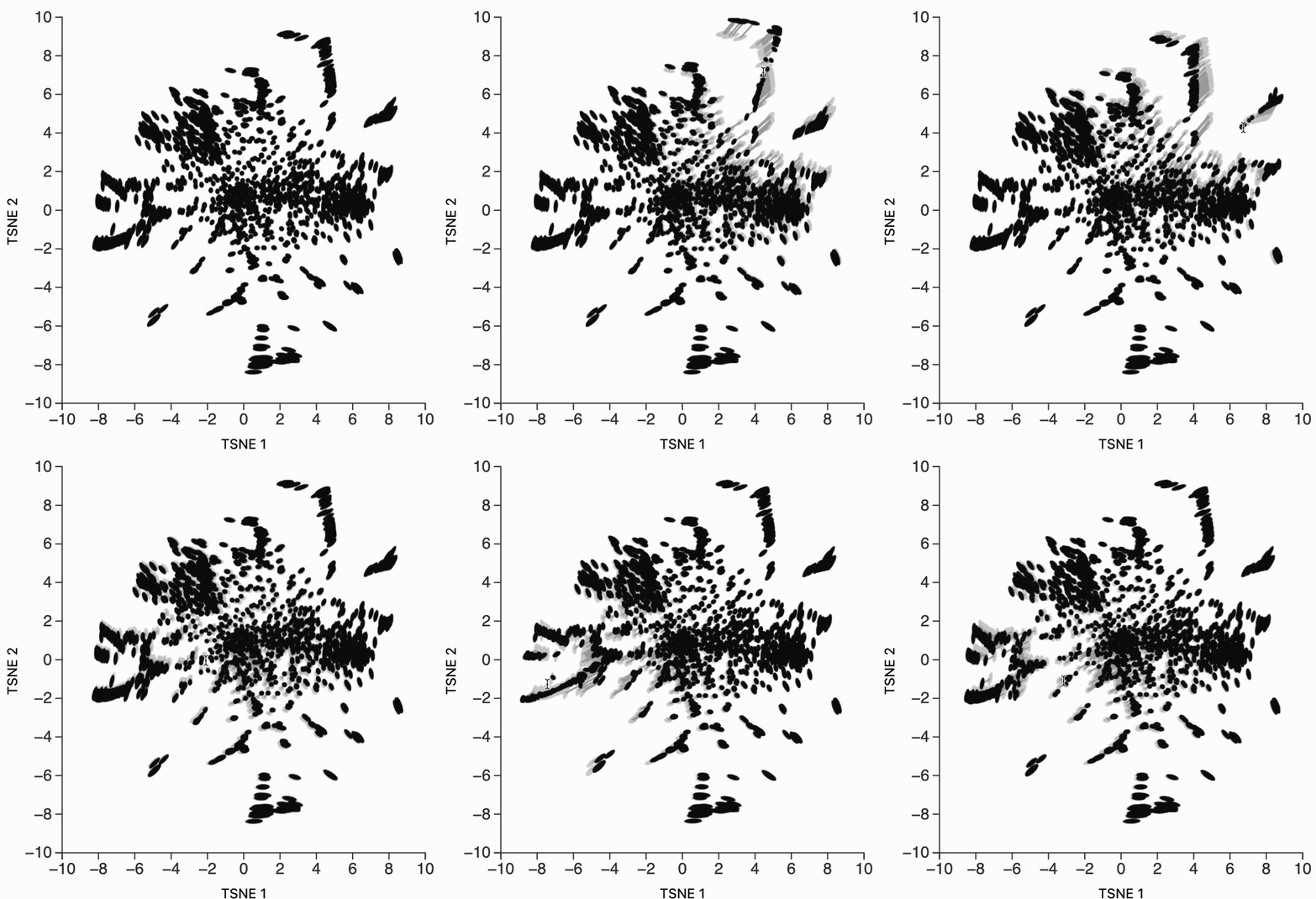
The local isometry visualization highlights some “threads” are more spread in the original data.
DensMap vs. UMAP
Both variation in ellipses and fragmented neighborhood statistics can be used to compare competing algorithms, similarly to (Xia, Lee, and Li 2024; Venna and Kaski 2006).
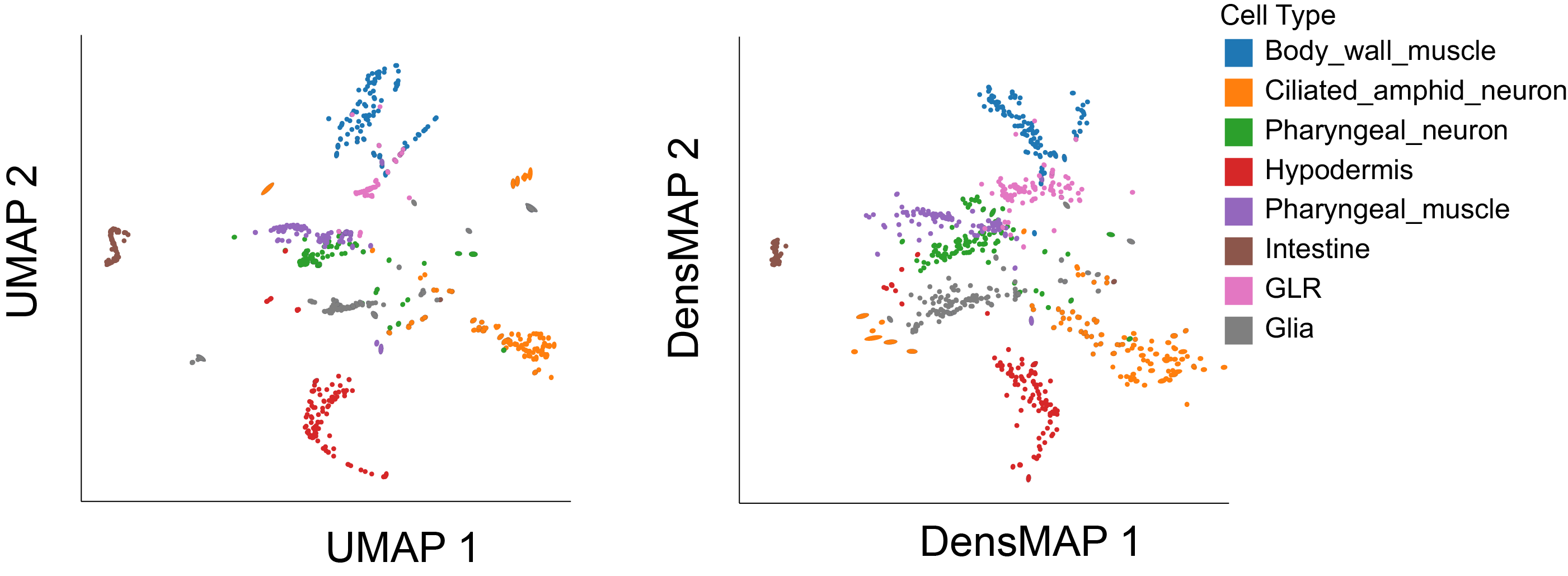
This example uses data from a C. elegans cell differentiation study (Packer et al. 2019).
DensMap vs. UMAP
Both variation in ellipses and fragmented neighborhood statistics can be used to compare competing algorithms, similarly to (Xia, Lee, and Li 2024; Venna and Kaski 2006).
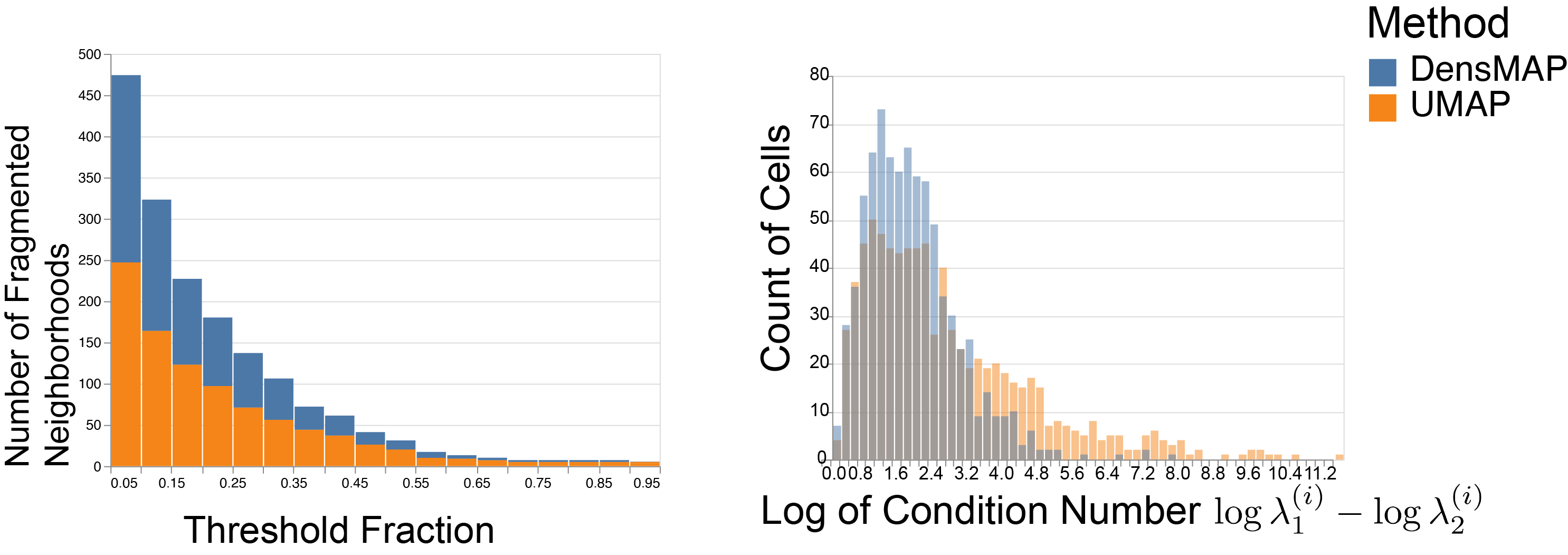
This example uses data from a C. elegans cell differentiation study (Packer et al. 2019).
Focus-plus-Context: Barplots
Stacked barplots visualize sample-to-sample variation in microbiome community structure. They struggle to show finer taxonomic resolutions.
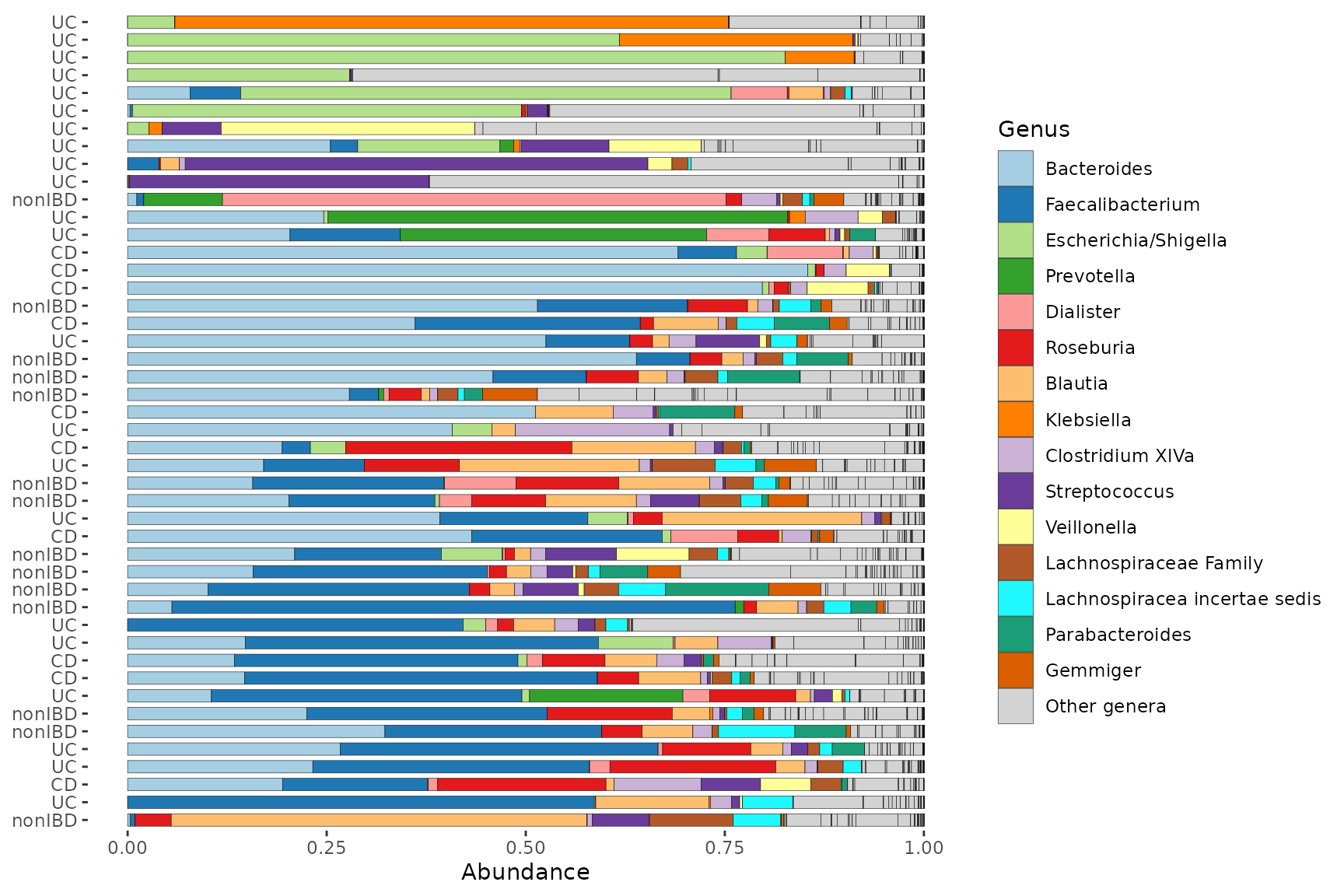
Figure from the microbiomeViz documentation (Barnett, Arts, and Penders 2021).
Focus-plus-Context: Barplots
Stacked barplots visualize sample-to-sample variation in microbiome community structure. They struggle to show finer taxonomic resolutions.
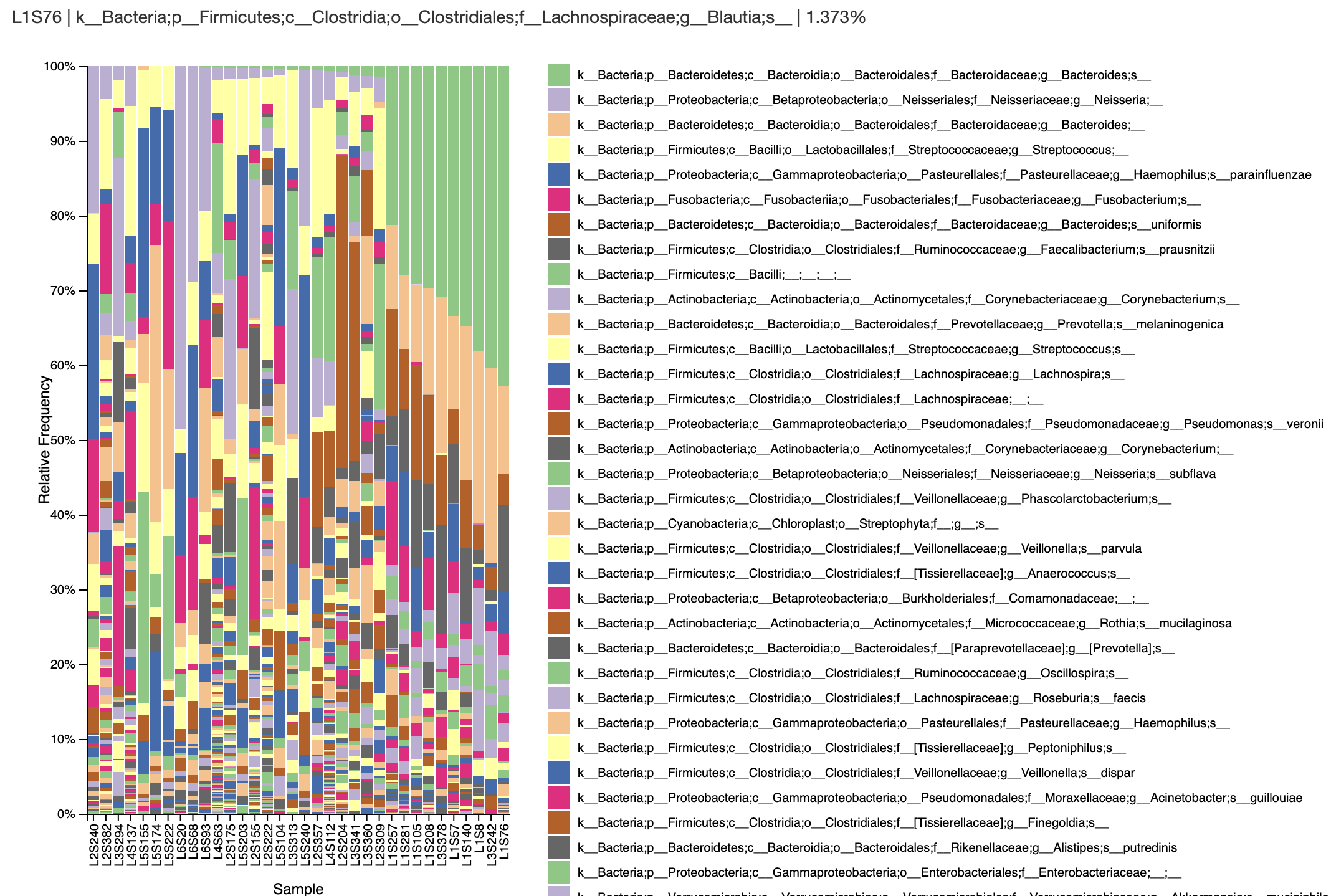
Figure from the Qiime2 View documentation (Bolyen et al. 2019).
Phylobar
Applying focus-plus-context reveals rare taxa abundances while preserving overall structure
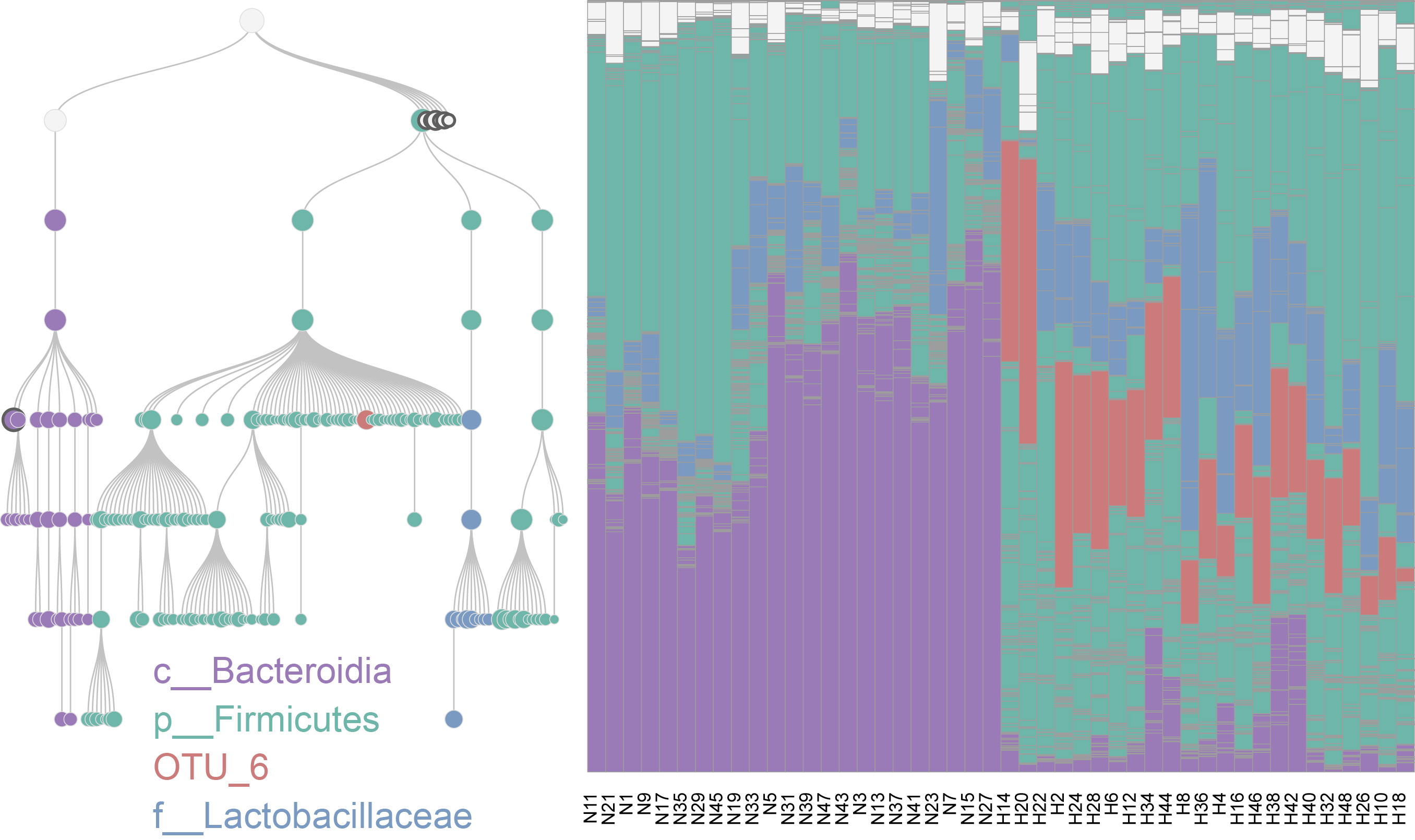
Figure from the phylobar documentation (Kuo et al. 2025).
Paths
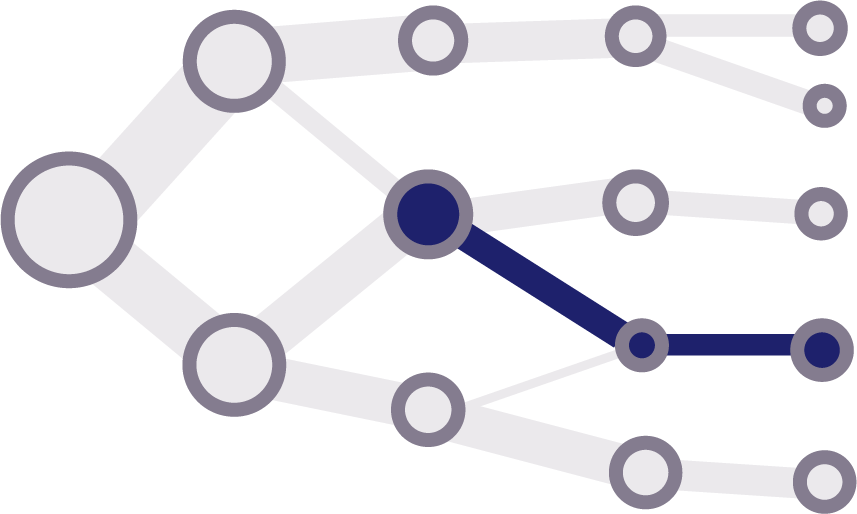
For each vertex \(v\), select the highest-weight incoming edge: \[e^\ast(v) = \arg\max_{e:\,\text{target}(e)=v}\bigl[\tilde{w}_{\text{out}}(e)+\tilde{w}_{\text{in}}(e)\bigr].\]
Iterating from largest to smallest \(l\) yields a set of vertex-disjoint paths, the number of such paths characterizes the alignment.

Paths
For each vertex \(v\), select the highest-weight incoming edge: \[e^\ast(v) = \arg\max_{e:\,\text{target}(e)=v}\bigl[\tilde{w}_{\text{out}}(e)+\tilde{w}_{\text{in}}(e)\bigr].\]
Iterating from largest to smallest \(l\) yields a set of vertex-disjoint paths, the number of such paths characterizes the alignment.

Paths
For each vertex \(v\), select the highest-weight incoming edge: \[e^\ast(v) = \arg\max_{e:\,\text{target}(e)=v}\bigl[\tilde{w}_{\text{out}}(e)+\tilde{w}_{\text{in}}(e)\bigr].\]
Iterating from largest to smallest \(l\) yields a set of vertex-disjoint paths, the number of such paths characterizes the alignment.
Paths
For each vertex \(v\), select the highest-weight incoming edge: \[e^\ast(v) = \arg\max_{e:\,\text{target}(e)=v}\bigl[\tilde{w}_{\text{out}}(e)+\tilde{w}_{\text{in}}(e)\bigr].\]
Iterating from largest to smallest \(l\) yields a set of vertex-disjoint paths, the number of such paths characterizes the alignment.

Paths
For each vertex \(v\), select the highest-weight incoming edge: \[e^\ast(v) = \arg\max_{e:\,\text{target}(e)=v}\bigl[\tilde{w}_{\text{out}}(e)+\tilde{w}_{\text{in}}(e)\bigr].\]
Iterating from largest to smallest \(l\) yields a set of vertex-disjoint paths, the number of such paths characterizes the alignment.

Refinement
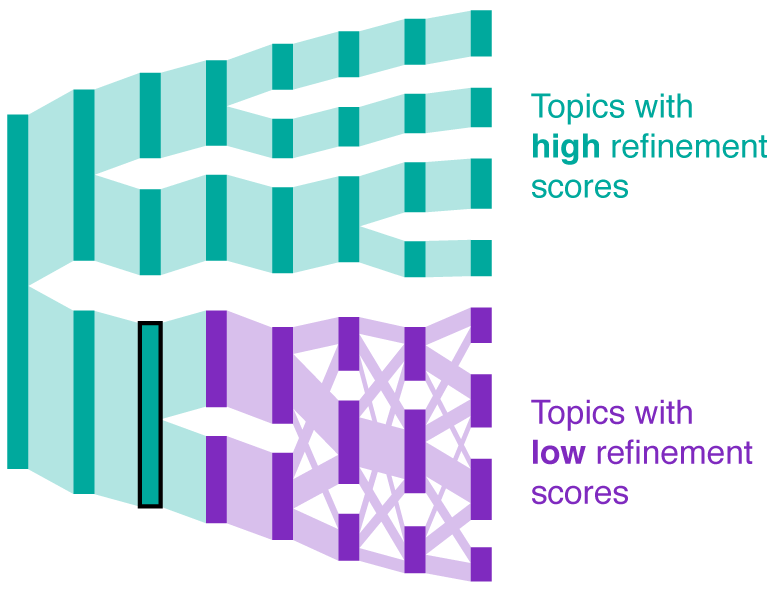
Parent specificity identifies two distinct regimes,
- High Refinement: Each topic receives the most mass from a unique parent, corresponding to a true or “compromise” topic
- Low Refinement: Each topic receives substantial mass from several parents, each corresponding to an arbitrary split of a true topic
Mammoth
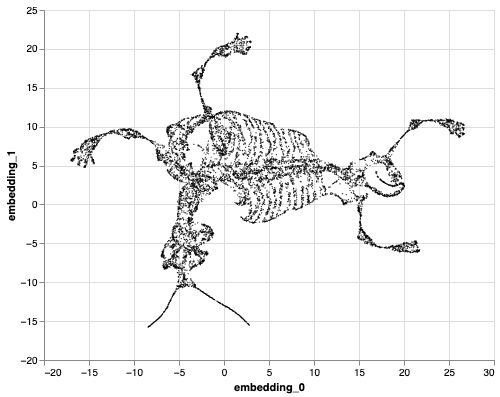
This example comes from (“Understanding UMAP — Pair-Code.github.io”; Noichl). The 3D skeleton scans were produced by the Smithsonian, and we can use nonlinear dimensionality reduction to “flatten” the skeleton into 2D.
Mammoth
This is the embedding when applying UMAP with a 50 nearest-neighbor graph and min_dist = 0.5.
Mammoth
Parts of the shoulders, head, and tail are further apart in the embedding compared to the original data. Most other distortions are points that are placed too close to one another.
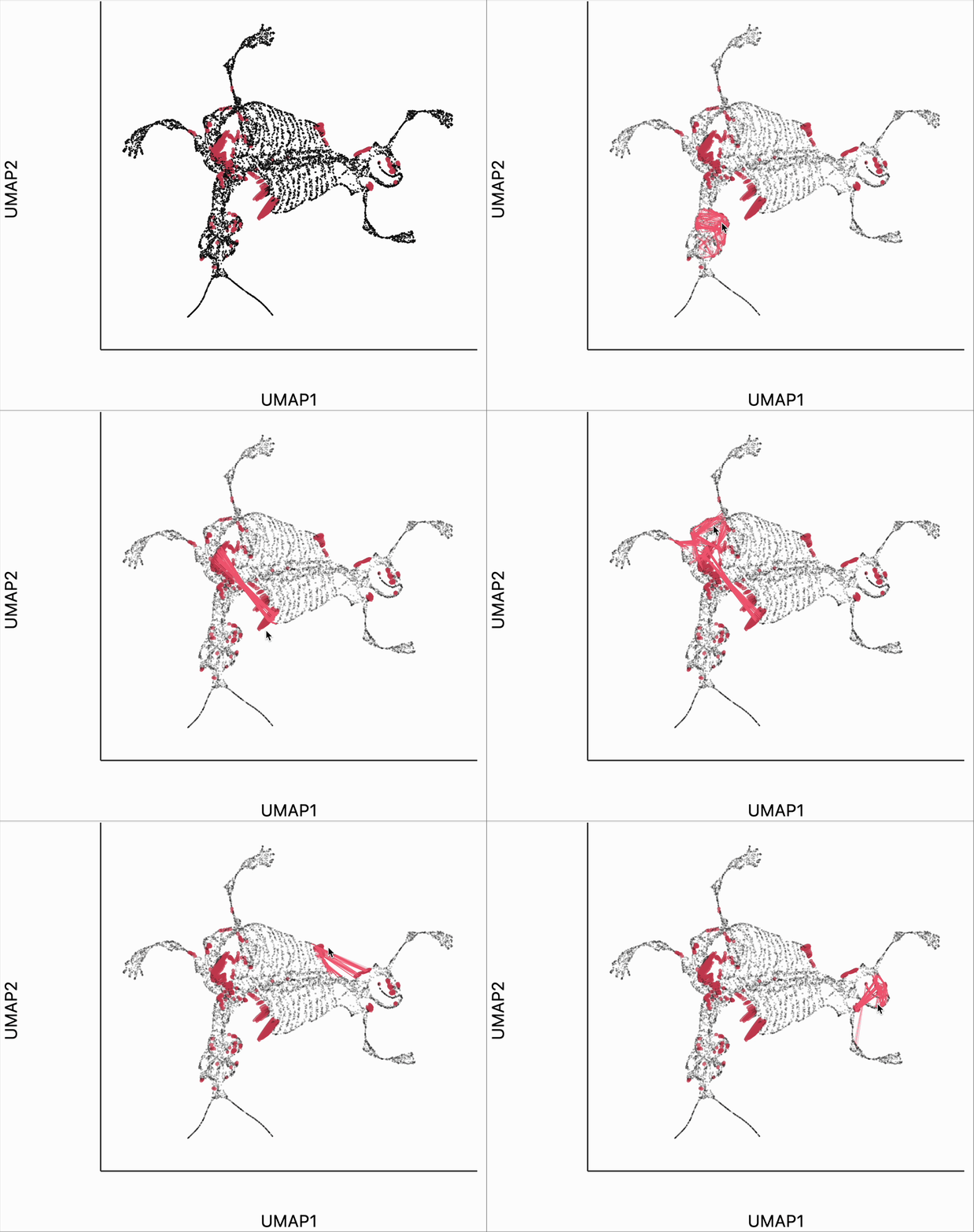
Mammoth
Parts of the shoulders, head, and tail are further apart in the embedding compared to the original data. Most other distortions are points that are placed too close to one another.
Interaction Gulfs
There are two classic challenges in interactive interfaces (Hutchins, Hollan, and Norman 1985),
- Gulf of Execution: The gap between what you want to do and how you specify it in the system.
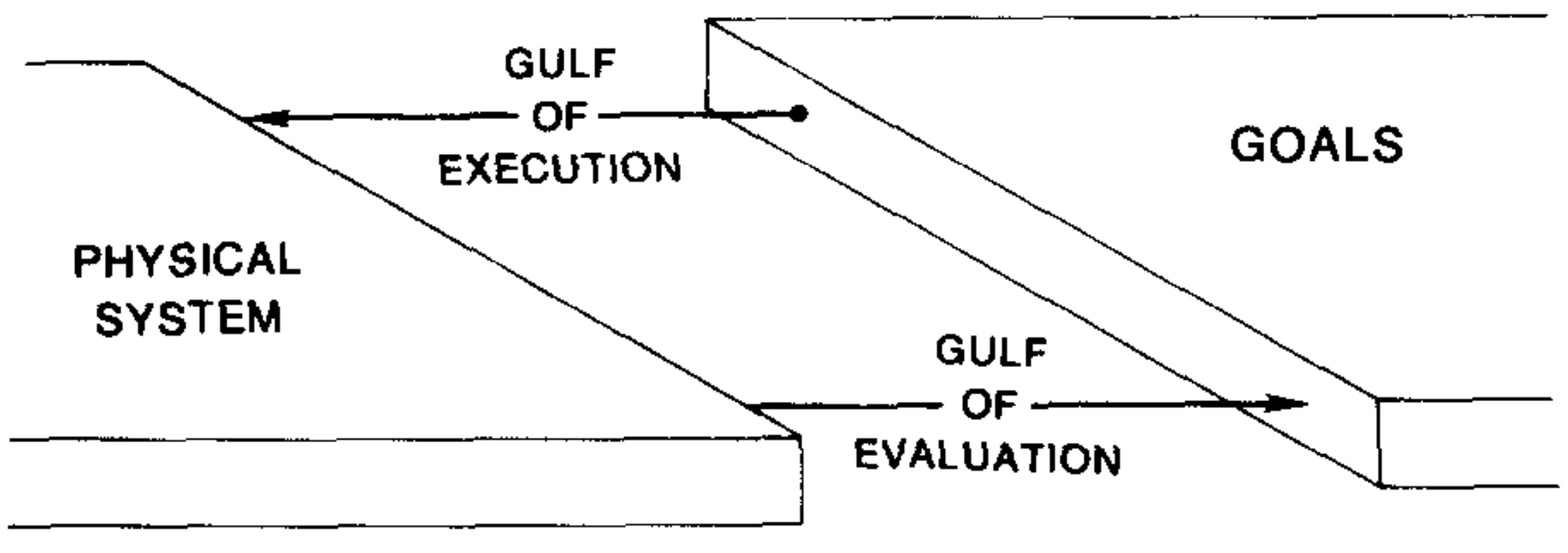
These challenges also apply to interactive data analysis.
Interaction Gulfs
There are two classic challenges in interactive interfaces (Hutchins, Hollan, and Norman 1985),
- Gulf of Evaluation: The gap between what the system shows you and an understanding of what it represents.
These challenges also apply to interactive data analysis.
Specious Art
Nonlinear dimensionality reduction has become the source of widespread concern in the single-cell literature (Chari and Pachter 2023).
We introduce two new diagnostic visualizations.
alto plots for choice of \(K\) in topic models .
RMetric plots for nonlinear embeddings.
Both are grounded in the data visualization principles that we review next.
Example: Antibiotics Time Course
To interpret topics, look for representative taxa. These species have higher probabilities in one topic compared to the others.
Result
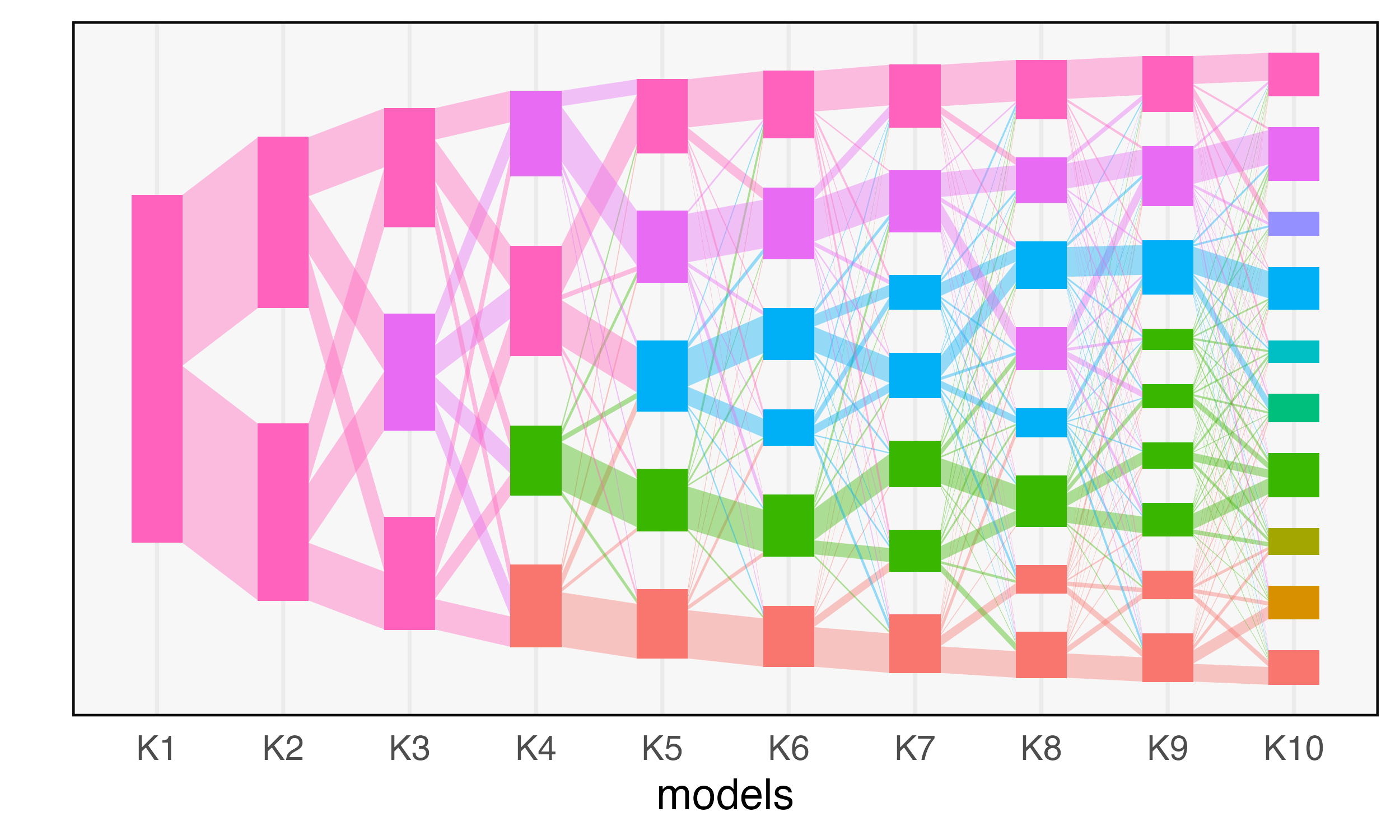
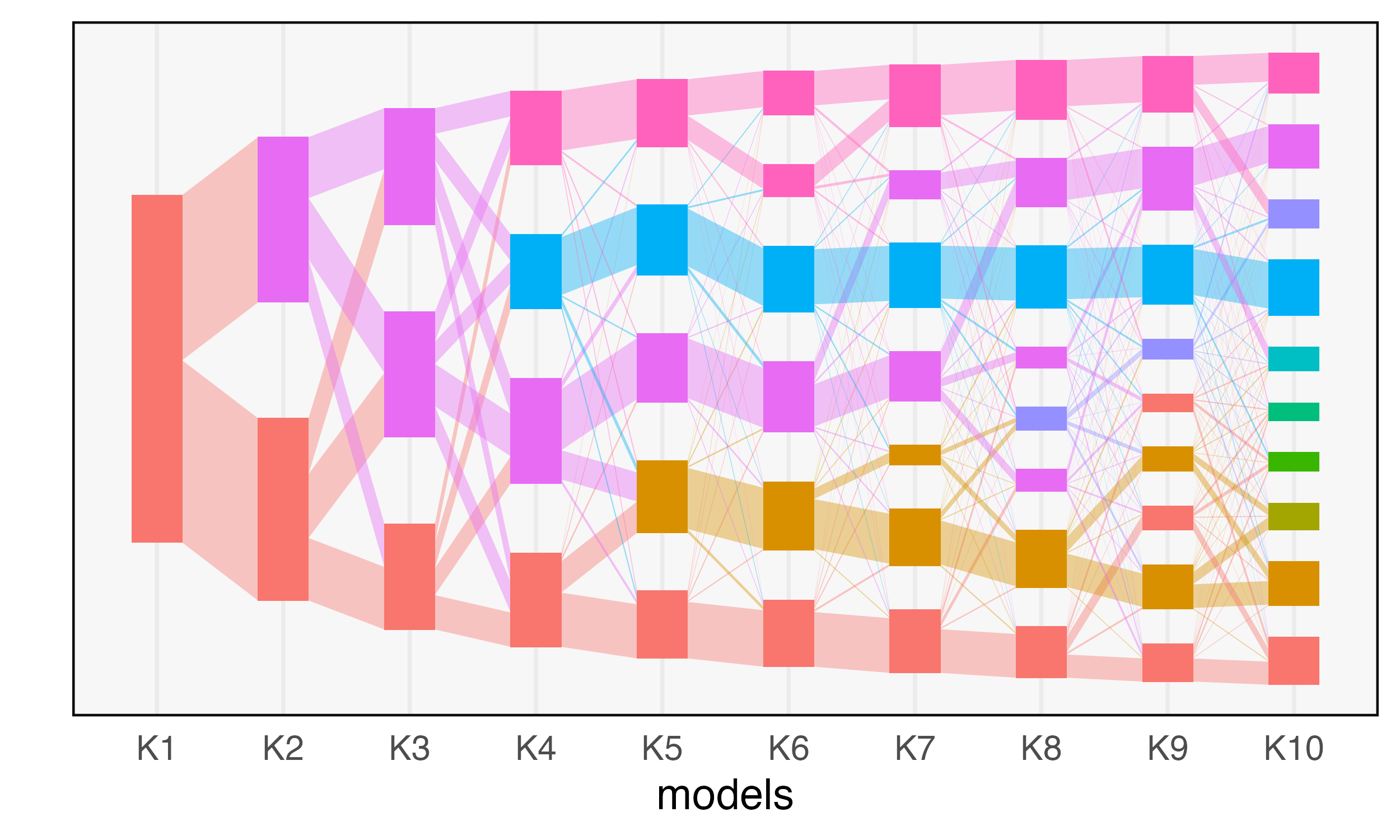
The alignment structure is sensitive to changes in \(\alpha\) and fragments when structure is not present.
Diagnostics
This structure is consistent across simulation runs, and the diagnostics quantify topic deterioration.
Dual Pushforward Metric
Alternatively, the gradients \(\nabla z^i\) of the embedding dimensions also reflect distortion.
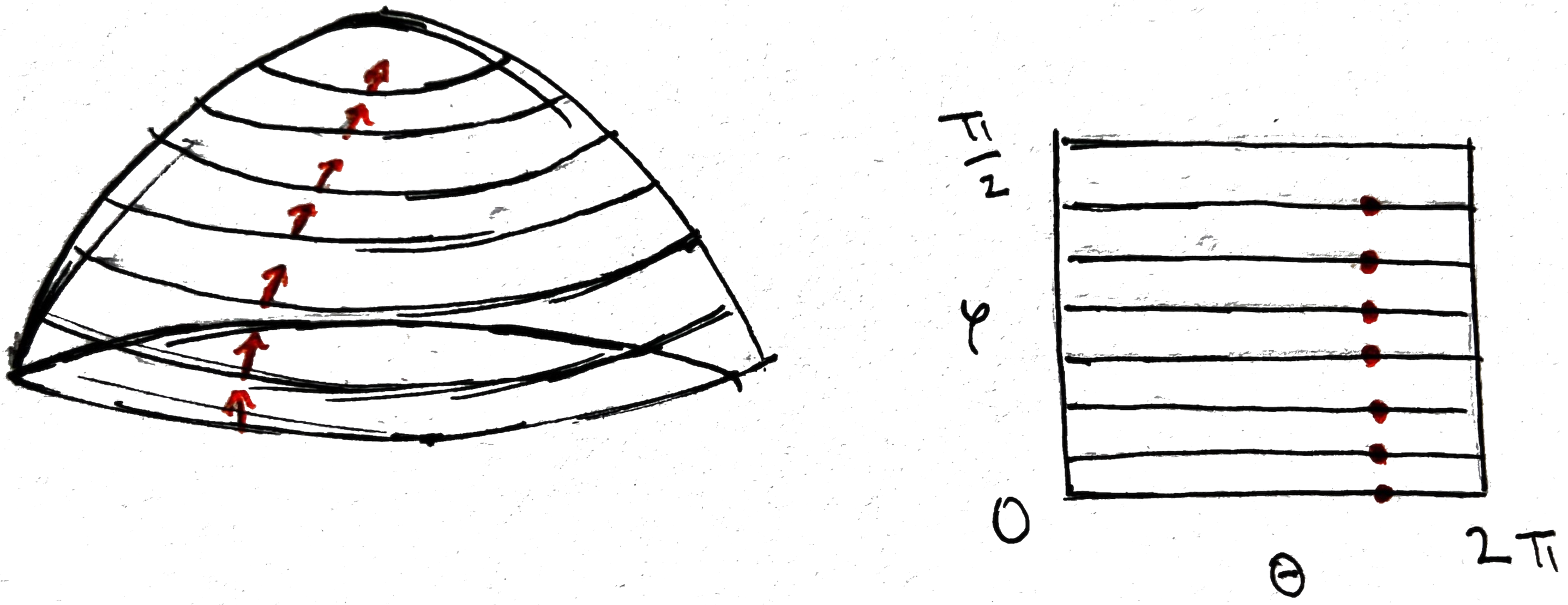
In contrast, the gradients \(\nabla z^{\varphi}\) don’t depend on \(\varphi\).
Comparison with LOO-map
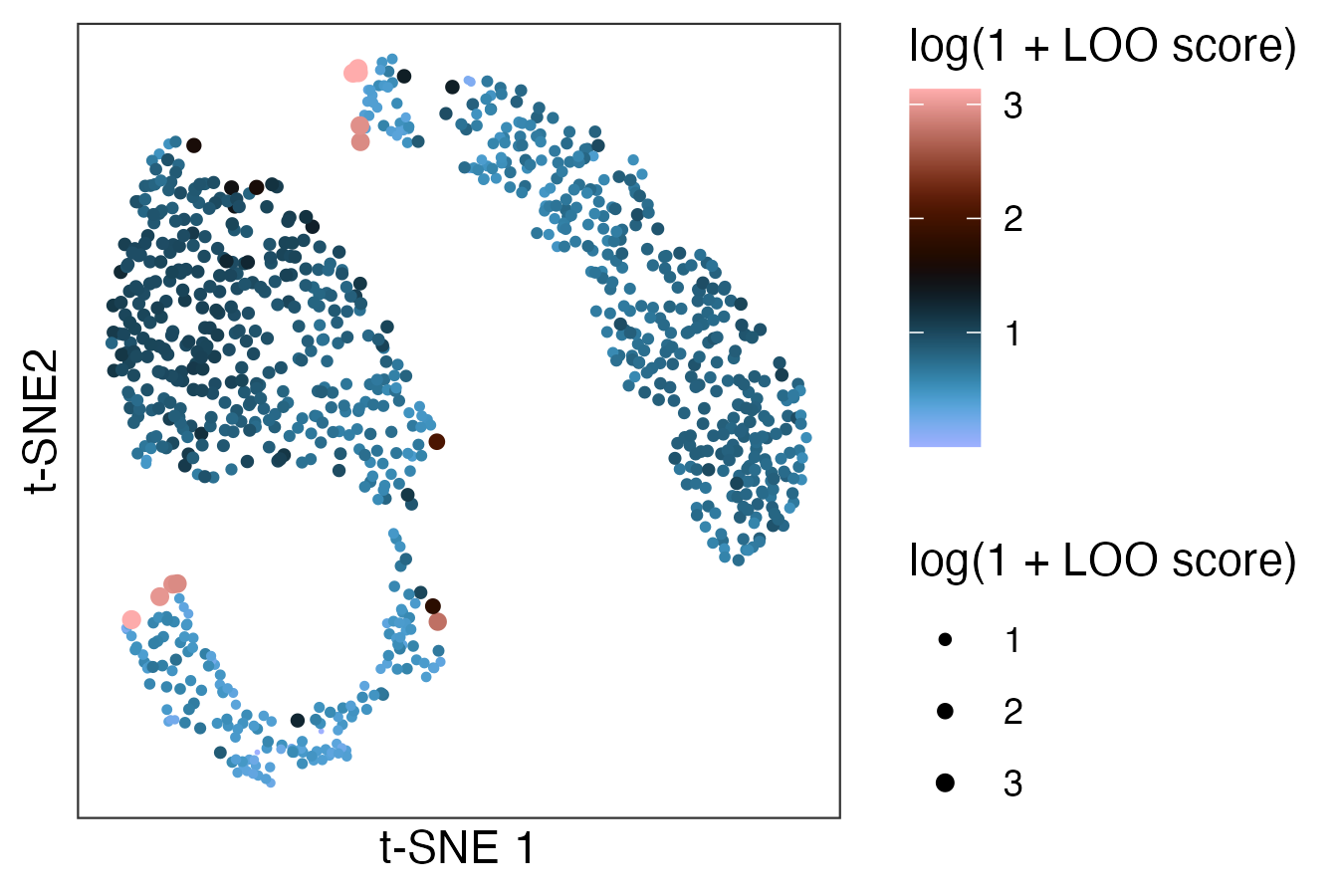
The stability-based algorithm (Liu, Ma, and Zhong 2025) gives a similar interpretation. But the visual encoding is more subtle, and the leave-one-out approach is time consuming even with approximations.
Distortions in \(t\)-SNE and UMAP
They can make high-dimensional random walks look artificially smooth…
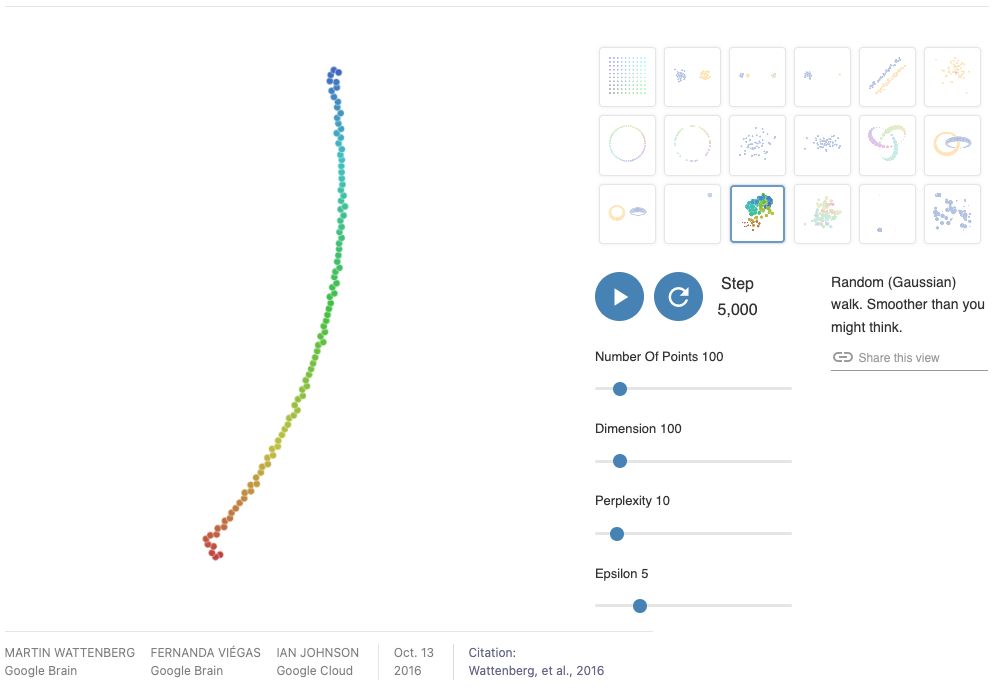 Example from (Wattenberg, Viégas, and Johnson 2016).